Nuremberg, the second largest city in Bavaria after Munich and about an hour’s drive from Regensburg, makes for a great overnight stay or two. Although this picturesque city isn’t as old as Roman Regensburg, it still boasts a fascinating and rich history: an imperial city in medieval times – evident in its well-preserved 11th century castle complex and city walls – it was home to the Imperial Diet of the Holy Roman Empire, commonly referred to as the First Reich. Because of this connection, Hitler chose Nuremberg as the epicentre of his magnificent rallies, cumulating in his megalomaniacal vision of the future of Germany under the Third Reich (we’ll cover this in a separate post).

Nuremberg’s sprawling but immensely walkable old town centre lies north of the Hauptbahnhof which bookends it at one end, with the imperial castle bookending the other. Besides the old city attractions, which are plentiful and straddle around the Pegnitz river, there are also other museums and places of interest (mostly associated with the Nazi regime’s height in power and fall from grace) that are located further away, but nonetheless are extremely important in understanding what is probably Germany’s darkest moment in history.

So let’s start with a brief history. Records trace the history of this old city back to 1050, which mentions of an imperial castle located between East Francia (the area east of the river Rhine populated by Franks) and the Margraviate of the Nordgau of Bavaria (this mouthful was a medieval administrative unit near where Regensburg is currently located). Photo credits to Wikipedia below.

From 1050 to 1572, the city expanded and simultaneously rose in importance due to its strategic location along key trade routes. Around the 11th century, Nuremberg was designated as one of the Imperial Diets, alongside Regensburg and Frankfurt, but not as a permanent Diet (as it was in Regensburg). After it elected Frederick II as the Holy Roman Empire, a grateful Frederick granted Nuremberg the Großen Freiheitsbrief, or Greater Charter of Freedom, to the city.

This was good news, as it meant that the city had some autonomy from rulers of imperial castles known as the burgraves. However, civil strife around that time and lasting to the 16th century also accounted for a series of persecution against the Jews in what is known as the Rintfleisch, where they were rounded up, expelled or burned at the stake, and their communities were bulldozed to make way for other city amenities. This would again be repeated in the 1940s.

Arguably, Nuremberg’s greatest era was when another Holy Roman Emperor, Charles IV, named Nuremberg as the city where newly elected Kings must hold their first Imperial Diet. This instantaneously made Nuremberg one of the three most important cities of the Empire. Charles IV also built the beautifully gothic Frauenkirche (Church of Our Lady) which now sits as a centrepiece in the expansive Hauptmarkt, except during every December when it is relegated to just a backdrop during the largest Christmas Market in Germany held in this very square.

In the early modern age, with the spread of Martin Luther’s Protestant Reformation from Wittenberg, Lutherism came to Nuremberg in 1525. In 1532 the Nuremberg Religious Peace was signed there, preventing war between Lutherans and Catholics. However this was short-lived, as soon after that, Germany was embroiled in the Thirty-Year War, one of the most destructive in European history, which essentially pitted the Catholics with the Protestants.
Fast forward to the Nazi era, in which Nuremberg was chosen to be the site of huge Nazi Party conventions, chiefly amongst them the Nuremberg Rallies. These famous rallies to showcase the might and discipline of the Party were held at Zeppelinfeld, located about 20 minutes away from the old city by tram. After the fall of the regime, trials were held for the key members of the Party; the highest ranking and most powerful amongst them: Hermann Göring – Nazi politician, military leader and Supreme Commander of the Air Force. These landmark trials, termed the Nuremberg Trials, were held at the nearby Palace of Justice and involved judges from the Allied countries (USA, Britain, France and the Soviet Union) who systematically and categorically build a case to try members of the Nazi Party for war crimes and crimes against humanity.

Nowadays, Nuremberg is a good place to wander and look back at a slice of Germany’s past. It is a must for anyone who wants to understand how this country came to be what it is today, unabashed of its successes but mindful of its haunted past; and to do so, you need to see it all: not just the trophies on the mantle, but also the skeletons in the closet – information to which you will gladly and welcomingly find in Nuremberg. This dichotomy is especially felt here; after all, this is the city that hosts the German National Museum, the largest of its kind celebrating the successes and triumphs of the German speaking people in the region, as well as in the Palace of Justice, a sobering reminder of that dark moment in its history and the refreshing honesty and remorse that comes with it.

Nuremberg remains one of the most visited cities in Bavaria, and besides the sights mentioned above, throngs of people flock there every December to partake in the enormous Christmas Market that takes over the entire old city. With all these reasons, be sure to make Nuremberg a part of your tour around Bavaria…nein, better make it your priority for a visit.

Feeling overwhelmed and not sure where to start? Not to worry, here are my top ten recommendations (and one food option) to help guide you along.
1. Walk around the Old City Walls
Start at the Hauptbahnhof, with its many high-speed connections to Munich in the south and Frankfurt in the east, and its large taxi rank and tram stop directly outside. Directly opposite is the Frauentor. This picturesque rounded tower at the base of the courtyard was part of the original city walls built in the 14th century and is one of the four key towers that once protected the city from invaders. The impressive sandstone was quarried locally, and intricate details of the structure reflects the craftsmanship of the era. During the Middle Ages, the courtyard below the tower served as a customs and security checkpoint where all visitors entering the old city had to register.

Nuremberg has one of the best preserved city walls in all of Germany. The walls, punctuated by lookout towers, stretch around the old city in a ring right up to the Imperial Castle. One of the more impressive spots is at the Kettensteg (chain bridge) and Schlayerturm (medieval tower) that stretches across the Pegnitz River. Taking a stroll around the walls in the morning before the city gets up is probably a perfect start to the day.

Entering through Frauentor, the Handwerkerhof Nürnberg (Craftsman Courtyard) is on your right. This area was redeveloped in the 1970s to honour Albrecht Dürer’s (Germany’s best known and arguably most talented Renaissance painter) 500th birthday, and now houses a medieval shopping village with small shops focusing on handcrafted traditional goods such as leather accessories, candles and pottery, and a slew of rustic and authentic German restaurants.

A wonderful mix of historical architecture and vibrant urban life, Handwerkerhof is a perfect place to relax, grab a beer and soak in the atmosphere. In winter, Nuremberg’s famed Christmas market starts from here, with a small cluster of stalls selling grilled meats, gingerbread cookies (Lebkuchen) and mulled wine (Glühwein), and stretches all the way to Sebalduskirche. Frauentor serves as a gateway into Konigstrasses, where you can wander along cobblestone streets, visit quaint shops and big brand names, and indulge in local delicacies.

2. Stroll down Königstrasse
Königstrasse, or King’s Street, is one of the four main routes to the Imperial Castle and the only route taken by the King on their way to hold their first Imperial Diet here in Nuremberg. With the introduction of the Hauptbahnhof in the 20th century, Königstrasse became the old city’s main road. This broad, tree-lined street with red sandstone buildings is filled with chain boutiques, trendy restaurants and expensive hotels. Königstrasse continues all the way to the Museumbrücke, across the Pegnitz, before changing name.

Just a few steps down is the Kirche St Klara, with a peaceful and modernist interior. Formerly a monastery, it was converted into practical municipal buildings when Nuremberg turned Lutheran. Today, St Klara is an ecumenical free church, meaning it is neither Lutheran nor Catholic, and welcomes worshippers of all denominations.

Beside it is a minimalist monument to the refugees of WWII and remembers the Bavarians who took them in after the war. Constructed in 1999, the reddish-brown open doorway signifies a welcome invitation. Beyond it is a metal plaque that lists regions to the east once populated by Germans, who had fled west into Bavaria to escape invasion (well, from a German’s POV) from the allies.

Towering over this is the Mauthalle (Old Granary), with its easily distinguishable sloping roof and protruding windows. These granaries – 11 of them around the city – help to ensure that residents would have enough food in case of famine or siege. Excess grain is stored in the attic behind the sloping roof, with the little dormer windows to allow ventilation. Now, the Mauthalle consists of various shops, an open air museum (we didn’t managed to see this) and a recommended beer hall, Tucher Cellar, in its cellar.
3. Visit the medieval churches
Past a large shopping centre and the steps leading to the entrance to the U-bahn, the large Lorenzkirche (St Lorenz Church) with its stained but beautiful facade looms into view. Constructed in the 13th century, its twin steeples are 80 metres high and visible from all around the city. The centrepiece of the square that surrounds it, St Lorenz is dedicated to Saint Lawrence, and was formerly of Catholic denomination before the iconoclasm of the Reformation swung by, converting it to become one of the most important Evangelical Lutheran churches in Bavaria. During the war, the church was badly damaged and had to undergo extensive restorations, but as it is with such important churches in Europe, the townsfolk came through and, proud of their rich heritage, rebuilt these icons brick by brick. Credits to TripAdvisor for the below photo.

St Lorenz is architecturally stunning, and with its towering height, it is almost daunting. The towering west transept with the twin towers sport various Gothic features, such as rosette windows, gargoyles and portals. Take some time to admire its main portal, adorned with various sculptures such as Adam and Eve, the Three Wise Men, Jesus and Mary. It also contains scenes from the Bible, such as the resurrection of Christ and an image of Hell. These were sculptured so that the facade didn’t look quite so plain, but mostly for the illiterate back then to understand the teachings of God.

Step inside to the cool and peaceful interior, and be amazed by the sculpture suspended over the altar. This is the Annunciation, carved in 1517 by a local citizen and master woodcarver named Veit Stoss. Some of these magnificent pieces were saved by concerned citizens during the aerial bombings of WWII by storing them in the Historic Art Bunker, and then later returned to their rightful places within the churches (read more about this later under the Art Bunker section).

Beside the altar and near the choir is the monumental and intricately designed tabernacle built by Adam Kraft, showing stunning imagery of Christ’s Passion scenes, from the Last Supper at the bottom to his resurrection at the top. With some foresight and true to his intent, he crafted the entire structure in stone except for the risen Christ at the top, which is made of wood, to – cue gasp from being mind blown – symbolise Christ as a living being.

This fascinating artefact also include’s the artist’s image embedded in his work – Adam Kraft is shown kneeling at the base carrying the weight of the tabernacle on his shoulders – perhaps a fitting metaphor when he first embarked on this project.

Besides St Lorenz, the other prominent churches in the old town include the Frauenkirche in front of Hauptmarkt, and Sebalduskirche a short walk north. Gothic-styled Frauenkirche sits on the site of a former synagogue, which was within the former Jewish quarters sited on swampy land and outside the city walls.

When the towns merged and the land near the river became valuable, the former HRE Charles IV allowed the removal of Jews as part of the pogroms and constructed this church in its place. With its close association to the Jewish faith, it’s no wonder that there’s a Star of David (the Jewish symbol) on the floor behind the main altar.

Just a few steps north is Sebalduskirche, one of the oldest churches in Nuremberg. St Sebaldus takes its name from Sebaldus, an 8th century hermit and Anglo-Saxon missionary to Germany who settled in Reichswald near Nuremberg, thus becoming the patron saint of Nuremberg. It was constructed in the 13th century and underwent further refurbishments later to widen its aisles and lengthened its steeples, and in the 17th century the interior was made more Baroque. St Sebaldus suffered damage during WWII but some of the unaffected areas include the Shrine of St Sebaldus, carvings by Veit Stoss and the stained glass filling the windows (which were hidden in the Historic Art Bunker).
4. Stand at Museumsbrüke and admire the Pegnitz
The Pegnitz is the river that bisects the city into two. It originates from the town of the same name, and spans 113km and meets the Rednitz River in nearby Früth. As it flows east to west through Nuremberg, it meanders around several small islands. Museumsbrüke is the main bridge that leads down from Konigstrasse to the main market square, HauptMarkt, and up to the Imperial Castle.

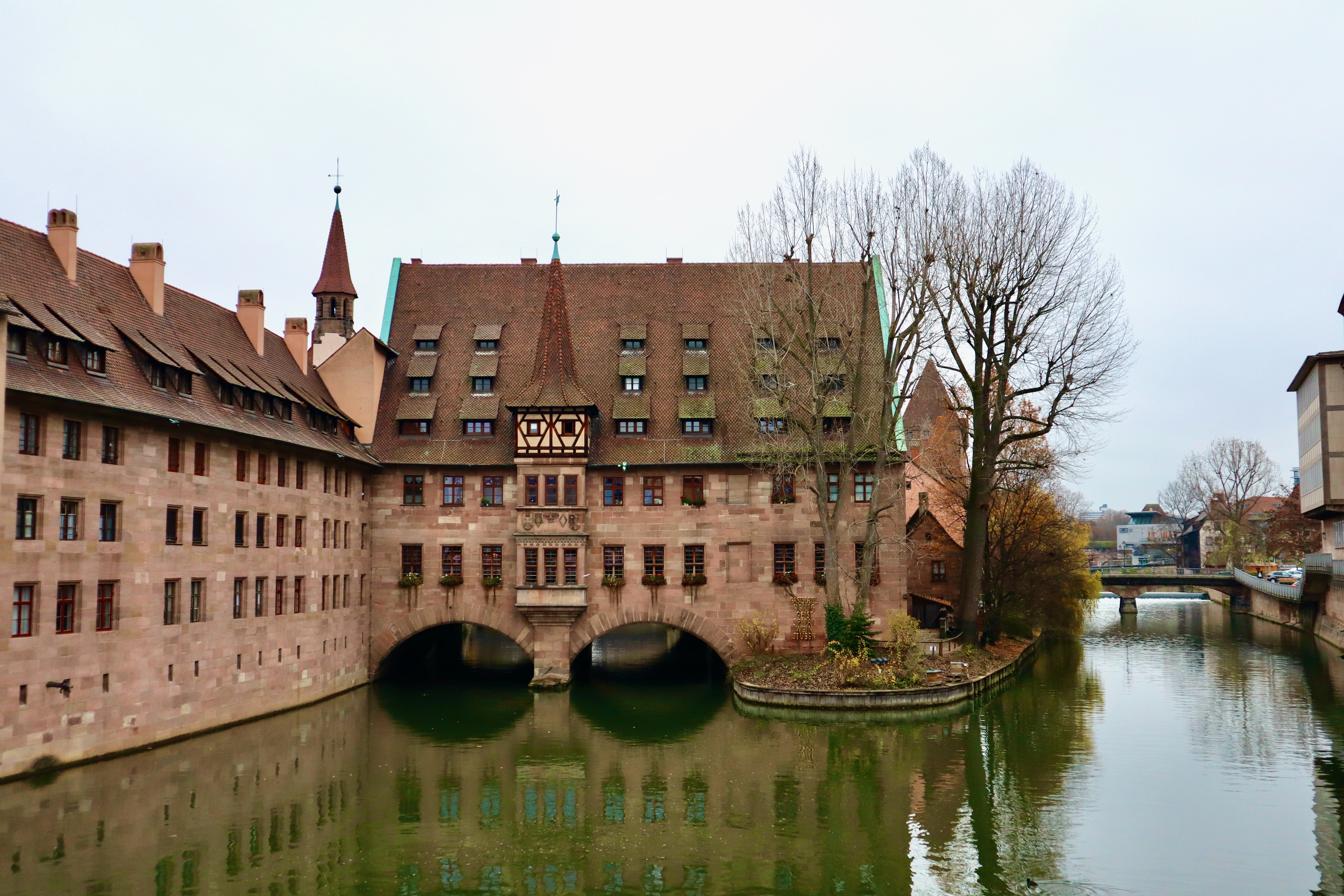
On the right is the little island of Schütt Insel, on which sits the picturesque Hellig Geist Spital, or Holy Ghost Hospital. Formerly one of the largest hospitals and municipal facility caring for the city’s ill, disabled and elderly residents, it was donated by the city’s richest resident, Konrad Gro𝜷, in the 14th century; no doubt a big believer of “do good on Earth and enjoy riches in Heaven”. Herr Gro𝜷 was the most well-known member of the Gro𝜷 family within the Nuremberg council, and one of the wealthiest entrepreneurs in imperial city, owning properties in and around Nuremberg. He also served as financier for the Bishop of Bamberg and Emperor Ludwig. If you want to see the symbol of the building, look for the dove beneath the the middle window under the turret. This river-spanning, red-bricked turreted building with the leafy trees at the side represents one of the iconic images of Nuremberg, and one can even dine inside it at the Restaurant Heilig-Geist-Spital Nürnberg, touted as a historical tavern offering hearty regional cuisine and beer with panoramic river views.

Spanning the river on the left is Fleischbrücke, or “meat bridge”, one of the widest at 15.3m with a span of 27m. When it was built in 1596, this single-span bridge was considered the most advanced in Central Europe because of its almost flat profile that required some innovative construction utilising abutments (the substructures at the end of a bridge span) that were built onto almost 2000 wooden piles. A similar use of technology was applied to another bridge in Venice, but research showed that both designs arrived organically and independent from each other.

As the Pegnitz flows through the city, further down and across several other bridges is the enchanting Kettensteg (Chain Bridge). This is an iron footbridge that holds claim to be the oldest surviving iron-chained bridge in Europe. Constructed in 1824, this engineering marvel is located directly at the Pegnitz’s outlet into the old town, in front of the Schlayerturm, a medieval tower forming part of the city’s fortifications. The narrow footbridge is approximately 68 meters long and has always been a pedestrian bridge since its inception. It was a bit slippery when I was there during the winter, as the sleet had glistened the cobblestone and timbers wet, but it provided for a picturesque setting with the fallen autumn leaves against the backdrop of the fortified tower and greenish waters.

5. Visit Hauptmarkt for Christkindlesmarkt
Every Christmas, Nuremberg is home to one of the largest (if not the largest) Christmas Market (or Christkindlesmarkt) in all of Germany. It’s so large and extensive that almost the entire old town transforms into one large festive bazaar.

Starting near Handwerkerhof, rows and rows of wooden booths, fairy lights, Christmas decorations and festivities spread downwards along the main thoroughfare of Konigstrasse, like a runway lit up at night, and congregates in front of Lorenzkirche as well as at Hauptmarkt in front of Frauenkirche. The markets continue, albeit at a quieter pace, up to the Imperial Castle, which usually organises its own version, sometimes with an entry fee.

Hauptmarkt, the old town’s famous square, becomes the focal point of Christkindlesmarkt, transforming into a large carnival with rows upon rows of stalls, tall and sparkling Christmas trees, the ornately Gothic Frauenkirche in the middle and the Schöner Brunnen (meaning beautiful fountain), a restored replica of a 14th century fountain crafted by renowned German stonemason Heinrich Beheim. At 19 metres tall and resembling a church spire, this Brunnen is not meant to only showcase the prowess of that era’s craftworks, but also conveys religious and philosophical ideas and beliefs, seen through the lens of the Holy Roman Empire at that time, such as the statues and motives portraying biblical scenes, church figures, philosophers and characters of virtue.

During December, however, the splendour and ornateness of the fountain is lost to the magical charms of the Christmas Market. And what doesn’t the market sell? It is almost a spiritual experience to wander around the stores, an amalgamation of age-old traditions, whimsical decorations and dazzling wonderment.

From a sumptuous smorgasbord of gourmet offerings, to traditional handicrafts and intricate artworks, to Santa’s workshops, bonfires and carolling…it’s Christmas on steroids, and there’s probably no other place on earth that does it better, so let’s get down to some details.

The concept of the modern day Christmas Market sprung up around the region of Austria and Germany during the Middle Ages, with Dresden and Nuremberg holding the candle for the first continually operating annual market. Very soon, this tradition caught on (well, how could anyone not enjoy a good party) and spread to other German speaking regions in Switzerland and Italy. Now, almost every country has some form and variation of a Christmas Market, even countries without winter (I can vouch for that in sunny Singapore). Within Germany, it continues to astound me that every town and city has its own form of Christkindlesmarkt, even in tiny villages where surely the local population must equal the number of stalls!

A typical market will usually carry all types of traditional and some new age foods and beverages. Common food items are grilled meat such as bratwurst, beef steaks and pork chops in a hard bun. Currywurst with fries or potatoes are also popular, as are reibekuchen (deep fried grated potato cakes served with apple sauce or mayo), lángos (kneaded dough with sweet or savoury toppings), smoked salmon sandwiches and Käsespätzle (pasta with cheese).

Some stalls also carry grilled or stewed mushrooms (champignons), cooked kale and roasted corn on the cob. Sweet treats such powdered doughnuts, stollen (fruit bread with raisins or nuts and coated in icing sugar or marzipan), marshmallows and fruits on sticks, heart-shaped cookies and lebkuchen (cinnamon cookies with various toppings) fill up every space of the store, making even adults squeal with glee and wishing for more stomach space. There’s enormous pretzels of a gazillion flavours that will keep you and your family filled through the winter. Wash the grease and sugar down at one of the many drink stalls that sell Glühwein (mulled wine) or eierpunsch (similar to eggnog), served hot in a customised Christmas-themed mug that you get to keep, with a fee, as a souvenir.

Then there’s the handicrafts, ranging from spiced Christmas wreaths that continue to smell of Christmas two years on, to wood carvings (usually hailing from the Black Forest) usually depicting traditional houses or the Nativity scene, Santa-inspired Christmas tree ornaments and windmill pyramids called Erzgebirge (basically a diorama on a carousel) which turns when heat from the candles rise to meet the windmill blades. In addition, there are countless of other types of knick knacks such as woollen socks and mittens in all shades and patterns, scarfs in equally dazzling colours, and one of the most interesting offerings: cookie cutters in all shapes and sizes that almost makes you want to start baking, which at this point segues nicely into this riddle: who stole the cookie from the cookie jar? The one who didn’t buy a cookie cutter from the magnificent cookie cutter stall.

6. Climb up to the Imperial Castle
Looming over the old city on its lofty perch, with its medieval bricked tower and timber frame buildings, is Nuremberg’s Imperial Castle (Kaiserberg Nürnberg). This complex consists of three sections: the actual castle itself at the western end surrounding the inner courtyard which now houses the Palace (Palas), Museum and Double Chapel; the Pentagonal Tower and the Walburgis Chapel, and the Luginsland watchtower and Imperial Stables at the eastern end.

Visitors usually enter via a steep ramp up to the site of the Deep Well (around the centre of the castle complex) and the ticket offices are just to the building on the right (daily in summer 9am – 6pm, combined ticket with Castle, Deep Well and Sinwell Tower: €9).

A castle has been standing here since 1050 when records of its existence first came to be known, as being a favourite stopping point for Hohenstaufen Kings on their royal journeys. The castle was further expanded on this rocky outcrop amidst the remains of the older buildings, where it was again a popular venue for future Holy Roman Emperors to attend their first Imperial Diet, after getting elected in Aachen and crowned in Frankfurt.

There are a few must-see sights within the castle. After buying your ticket, take a queue outside the Well House (guided tour only) to see the rather exciting demonstration by castle staff on how deep the Deep Well really extends below the surface.

While first documented in the 14th century but most certainly older, this 50 metre deep bore used to be the single source of fresh water supply for the castle. Within the half-timbered, two-storey Well House, in the centre of a small room, is a parapet built of sandstone ashlars, backed against a large an information board about the history of the well and a cross-sectional diagram showing it plummeting to a fresh spring far below. The helpful staff will first pour a jug of water down the well and ask you to listen for the splash (well, it took longer than expected), and then lower a candle into the depths to a point where it is just a pinprick of light in an otherwise black void, while an LED light simultaneously lowers down the cross-sectional diagram to show the exact height of the candle within the well.

After peering into the deepest point of the castle, take a climb up the Sinwell Tower to the tallest part of the castle, for sweeping views of the old centre of Nuremberg (truth be told, the views from the courtyard are already breathtaking). Used previously as an observation post to detect advancing invaders, the Tower also has an exhibition of photos showing the castle and city after destruction in WWII (the tower and its wooden roof miraculously survive the bombing).

Next, visit the Palas and Imperial Castle Museum by stepping through the glass doors at the ticket reception office into the inner courtyard. It is a picturesque scene with half-timbered houses, sandstone-coloured and vine-covered bricked walls, with a lone tree in the middle.

From the courtyard, enter into the rather spartan Knights Hall, unchanged since the 15th century. This two-aisled room with a transverse beam ceiling is the place where the Emperor received guests, met important people and tended to administrative matters. It is devoid of much decorations as the royal retinue is always on the move with a “pack-as-you-go” mentality. The room has informative panels on the walls and nice bay-windows to afford one with views of the old city below.

Next, step into the breathtaking Romanesque Double Chapel, which survived unscathed from the war. An airy, light-filled two storey room with four slender limestone columns in the middle and a high altar with a wooden cross at the background, this Double Chapel has two floors; a lower one (called St Margaret’s Chapel but not open to the public) for commoners, and the upper gallery for the Emperor and his family, with a convenient doorway to the adjacent Imperial Apartments so he can attend Mass just after crawling out of bed. A Double Chapel typically consists of two chapels with the same ground plan one above the other, which can be connected through an opening in the middle so that the congregation in either chapel can at least hear the service in the other one.

Climb up the staircase into the Imperial Hall, used for festive purposes and as a dining hall during visits by the emperor.

It now houses much information and exhibits on the history of the Imperial Castle, with a particular emphasis on the daily functions of the Holy Roman Empire, of which this castle played an important role. The Imperial Hall leads into the Imperial Apartments, which showcases the Emperor’s Living Room, Chamber and Insignia Corridor.

After the tour around the Imperial Castle Apartments, exit back into the courtyard where you can take another walk around the castle’s ramparts to enjoy a 360 degree view of this magnificent city.
7. Walk the old city streets
Back down on the winding streets, towards the western half of the old city, are some of the finest half-timbered buildings one can find. Walk along the cobbled streets of Ob. Schmiedgasse which emerges into a small but cosy square called Tiergärtnertorplatz bordered by Nuremberg’s medieval walls, with one of the towers, or Turm, rising above the square. It’s also at this junction that you’ll find Albrecht Dürer House and the Historic Art Bunker, but we’ll get to that later.

In front of this square is the Pilatushaus, a seven storey late Gothic residential building with a cream and brown half-timbered facade that is one of the several houses in the vicinity that survived the war. Built in 1489, it belonged to armour maker Hans Grünwald and was later the residence of Hans von Aufseß, the founder of the Germanisches Nationalmuseum, which we will see later. Pilatushaus is undergoing an extensive renovation since 2024 to install a restaurant, apartments and offices, with the lucky occupants no doubt getting panoramic views of the old city from the highest floor.

At the corner of the building, between the sandstone ground floor and the half-timbered upper floor, is the figure of Saint George, in his armour and lance, slaying a green dragon. Built to commemorate the builder and his occupation, it is meant to signify “The House of the Armoured Men”. At the foot of the building is a bronze statue of a rabbit, created by Jürgen Goertz as a nod to Albrecht Dürer’s 1502 masterpiece of observation art titled the Young Hare (Feldhase). However, this new take on the rabbit looks like it was high on LCD when it was struck by a car. There are chairs around and a nice little cafe that must surely be a great spot for a cup of tea and a rest during the summer.
Next, take a left onto Albrecht Dürer Strasse and down onto Weißgerbergasse, a handsome street lined with picturesque and beautiful timbered buildings in bright and pastel colours that miraculously survived the war.

Add in charming street lamps, inviting alfresco cafes and bars with amazing dining, drinking and sweet-treating options (such as Die Kleine Eismanufaktur, possibly Nuremberg’s most popular ice cream parlour) and a pedestrianised cobbled street, Weißgerbergasse is straight out of a Brothers’ Grimm fairytale story; the quintessential medieval Bavarian town.

The street leads down to Kettensteg, the chain-linked bridge, and the city walls with Schlayerturm straddling the river. Wander down at dusk when the city winds down, the lamps bathe the street in a warm glow, and you’re alone with just your thoughts and a stunning view.

8. Visit Albrecht Dürer’s House and the Historic Art Bunker
Nuremberg is proud of its native son, Albrecht Dürer, who is arguably Germany’s most famous artist. The house which Dürer lived and worked for 20 years, and ultimately died in, is a massive half sandstone, half-timbered structure at the corner of Neutormauer and facing Tiergärtnertorplatz. Germany’s first memorial site to an artist, Albrecht Dürer’s House (Albrecht Dürer Haus) has now been turned into a museum (Tue – Sun, closed Mon, 9am – 5pm, €7.50 for adults) and it is not only one of the few surviving burgher houses from Nuremberg’s golden age, but even more significantly, it is the only surviving 15th century artist house in Northern Europe. Its rooms, though not original, have been painstakingly replicated to show visitors what it was like living during the era.

Dürer, who studied in Venice, was a painter and significant contributor to the German Renaissance. He was especially well known for his printmaking in woodcut and engraving, which was spread all over Europe. In fact, some of his well known work resides in the museums of Cologne.

A special feature of the museum is the tour (Sat, 2pm, in English) led by an actress playing Dürer’s wife, Agnes, complete with the full garb of period costume such as bonnet, dress and house keys. She brings visitors on a tour of the rooms such as the workshop, with a demonstration on the printing techniques using the working printing press, and a room with copies of Dürer’s most famous paintings and woodcuts. There are also other changing exhibitions such as a presentation of the original engravings and woodcut prints, as well a history of the Dürer house (telling the tale of the heroines behind the efforts to save the house during the war raids) and its residents, chiefly Albrecht Dürer.

Opposite, the Historic Art Bunker (Historischer Kunstbunker) (accessible only with guided tours; daily, 11am and 230pm with more timings on Fri and Sat; €12) is a series of cellars buried deep underneath the rocky outcrop of the Imperial Castle that once served as a beer storage facility but were then used by quick thinking citizens to store precious artwork during the aerial counter-bombings by allied forces during WWII. Following the heavy bombing of Dresden and other important cities such as Hamburg during the war, the citizens of Nuremberg foresaw the same fate for their city, and proceeded to equip these cellars with all kinds of systems to provide optimal conditions to store treasures such as Nuremberg paintings, engravings, regalia of the Holy Roman Emperor, works from Veit Stoss and stained-glass windows retrieved from churches, so that these could be preserved once the war ended (probably without knowing which side would win).
The tour of the Bunker begins with descriptions of how the citizens of Nuremberg were prepared for war and how they were motivated, at all costs, to prevent the total destruction of all their city and its monumental works. This meant taking measures to safe-keep moveable items in underground bunkers and encasing other non-moveable structures (such as the Schöner Brunnen at HauptMarkt) in concrete for protection). Sadly, despite all these measures the city was almost completely destroyed; photos along the tunnels show the extent of damage inflicted. However, the story continues of the determination and perseverance of the townsfolk who toiled tirelessly to rebuild this city from ruins.
Now, I have to admit that I did not manage to visit both the Dürer House or the Historic Tunnels on account of the time limitation, so my descriptions here are based on research from the museums’ websites, travel books and online articles. Nonetheless, I hope to come back one day and polish off all the other amazing sights in Nuremberg.
9. Explore the German National Museum
Another fascinating museum within the old city walls is the German National Museum (Germanishches Nationalmuseum), an insightful look and celebration of the cultural history of the German speaking world (Tue – Sun, 10am – 6pm; closed Mon, Wed till late; €10). Founded in 1852 by Franconian nobleman Hans Aufseß (the same guy who stayed in Pilatushaus), the museum is a modern and sprawling structure (except for the section set in a Gothic former Carthusian monastery) sitting just in front of a row of majestic pillars.

Entitled the “Way of Human Rights”, these pillars were crafted by Israeli sculptor Dani Karavan, on which are engraved all articles of human rights as declared by the United Nations. In light of the atrocities committed by Germany during WWII, this monument is Germany’s promise to continuous uphold and champion these rights as universal values for all mankind.

The German National Museum tells the story of 600,000 years of European culture, art and history. Sprawled over three levels, it covers topics such as nature, art and historical items from the various epochs such as Prehistory and History, the Renaissance, Baroque and the Enlightenment. Its artefacts include pieces such as Scientific Instruments, Crafts and Medicine, Clothing, Musical Instruments, Weapons and even Toys, and with a collection of more than 1.3 million objects, this museum devotes the largest body of work representing the cultural history of German-speaking countries.

In 1857, the Bavarian king presented to Hans Aufseß a former 14th century Carthusian monastery, constructed of red sandstone with beautiful windows, at the southern border of the old city. The ensemble of cloister, church and monks’ dwellings offered enough space to present the cultural and historical connections of these German speaking regions.

The museum expanded in the 20th century through the construction of neo-Gothic buildings at the Frauentormauer and others, but after the destruction during WWII, the museum was extensively rebuilt and its current exterior is formed by the buildings from the 1950s and 1960s, as well as the more modern glass facade that constitutes today’s entrance hall.

Within, the museum is a treasure trove of amazing finds, such as the world’s oldest surviving terrestrial globe, the Earth Apple, crafted by Nuremberg native Martin Behaim in 1492 and the Golden Cone of Ezelsdorf Buch, made out of thin sheet gold attached externally to long conical and brimmed headdresses, founded in Ezelsdorf near Nuremberg in 1953 but believed to have been crafted in 900BC.

The museum also contains the largest collection of historical musical instruments in Europe, mostly the square piano, clavichord and harpsichord; artwork and woodcuts from Dürer (the only originals in the city) and Tilman Riemenschneider, a German woodcarver and sculpture once active in Wurzburg and famously known for his Holy Blood Alter now displayed in Rothenburg.

10. Try the Nuremberg Sausage
As it is with in Germany, each city has its own special brand of sausages (or würst) and Nuremberg is no different. Called Drei im Wreckla, this staple consists of three small, crunchy grilled pork sausages flavoured with garlic, peppercorn and marjoram, stuffed into a crusty bun. It is then topped with a sharp yet sweet mustard, or alternatively, sauerkraut. You can get this famous snack at restaurants, food stands and carts scattered around the old city – and yes, they can only be made in Nuremberg; so serious are they with this creation that Drei im Wreckla has earned the European Union’s highest cultural food honour: Protected Geographical Indication.

One of the more famous options is the Bratwursdose Nürnberg, a red-white striped stand looking like a mini-circus venue, handily situated along Brunnengasse, which makes it a convenient stop after visiting the exhausting German National Museum. It will leave you smacking your lips and recharged for our next attraction, a fascinating museum by Germany’s national railway operator, Deutsch Bahn (DB).
11. Tour the DB Railway Museum
Finally, the last but certainly not the least of all the attractions within or near the old city is Deutsch Bahn’s German Railway Museum Nuremberg (Tue – Sun, closed Mon, 9am – 5pm, €9 adults), or (DB Museum Nürnberg), situated within the imposing Nuremberg Transport Museum located just a few blocks away from the Hauptbahnhof. One of the oldest technical history museums in Europe, the railway museum covers two buildings – the main one with some life-sized historic train exhibits, immensely detailed train models and a large working model railway on the second floor (image below taken from Wikipedia); and another section (Halle 2) of train exhibits housed in a shed across a road, with some located at their outdoor display area.

Starting at the main building, the interesting information panels and exhibits take you on a fascinating journey of over 200 years of railway history and how it had impacted every facet of our world imaginable, transforming rural landscapes into suburbs and towns into megacities. The story starts with humble origins in 1835 when the country’s first line, which ran between Nuremberg and Fürth at a distance of 6km and using a locomotive imported from Britain, was opened. Since then, its amazing popularity and success catapulted Germany from an agrarian society into the industrial age. Germany is now one of the most connected, most developed and has one of the speediest train systems in the entire world – its Inter City Express (ICE) trains, with the white livery and red stripe, is famous throughout for its speed, reliability (well, some would argue that standards have somewhat slipped over the last decade) and safety.

The museum does a good job of explaining this history with some interesting nuggets of information, and the model specimens are breathtakingly detailed. Being Germany, there is also a section on how the railways, with the creation of the German State Railway (Deutsche Reichsbahn) in the 1920s, served the democratic Weimar Republic that formed after WWI and the dark ages prior to WWII. The former was a period of flourishing technological progress and economic growth, where steam engines were built to run faster, pull more carriages and burn coal more efficiently.

Inevitably, this is followed by the darkest chapter in German railway history: the Reichsbahn’s role in the crimes of National Socialism, chiefly its notorious association with the deportation of millions of Jews, Sinti and Roma to the extermination camps at Auschwitz in Poland. Sombre photographs of Jews being piled into cattle cars are a main feature, accompanied by the type of locomotive models being used, with a commentary that strikes a balance between captivating yet introspective.
Besides the models, there are also a few tracks leading directly into the building on which are housed several iconic rolling stock: an ICE driver carriage representing the modern age, the oldest steam locomotive in Germany still preserved in its original state and part of a royal blue, crown-topped carriage that formed King Ludwig’s railway entourage (no, not the photo below).

Upstairs on the second floor is the Modellarium, comprising a further collection of 160 1:10 scale models. These have been built over the years since the end of the 19th century and are very finely detailed. They comprise all forms of rolling stock: from locomotives, to trams, to Electric Multiple Units (EMUs) of high speed trains, and even a showcase on the unsung heroes of the railway – the yellow engineering trains that help built, repair and maintain the vast rail network throughout the country.

For those who want a bit of train action, there is also a large model railway (well, sizeable but not as impressive as the Miniature Wonderland in Hamburg) at the second floor, with 500 metres of track, 80m2 of model railway magic and a unique use of relay technology (5,000 relays), making this historical model somewhat of a very special experience. Traffic controllers manage up to 30 trains at any one time running around the scenic landscape, complete with viaducts, stations, ports and shunting yards, and demonstrate realistic train movements and shunting operations (usually every hour).

Another set of life-sized exhibits, stabled on two tracks, are across the road inside Hall 2. These are probably some of the most exquisite and unusual trains I had ever seen, and it’s a must-see for train spotters.
The first is the DRG Class 05 locomotive, maroon red, looking as sleek as any modern invention, and imposing at the same time. After the success of the Flying Hamburger, a diesel locomotive, in the 1930s, Germany started to experiment on faster steam locomotives that had an aerodynamic design. Even the wheel-sets were covered to minimise drag. Running on the Berlin to Hamburg line, some of these variants achieved a record-breaking 200km/h before it was beaten by the mighty Mallard steam engine from Britain, now preserved in the York Railway Museum, whose record of 203km/h still stands today (for steam engines, that is).

Another futuristic model is the DRG Class SVT 877 Hamburg Flyer, sometimes known as the Flying Hamburger, which was Germany’s first speedy diesel train travelling at an average of 124km/h. Consisting of a two car-configuration, each with a driver’s cab and passenger carriage, it is credited with establishing the fastest regular railway connection in the world when it entered service in 1933. Besides the prototype train, of which scraps were pieced together from remains after WWII and interred in this Hall, there were another 4 sets developed – one of which has been completely preserved at Leipzig Station.

Just behind is the outdoor exhibition area, comprising some rotating train exhibits and other interactive activities that allow you to operate hand-lever signal boxes and change signalling lights. On certain summer months, there’s even an opportunity to travel onboard a light railroad for a leisurely ride across the open-air grounds.

The above sums up the top 11 fabulous sights and activities to do in Nuremberg. Check out my other upcoming post for the best sights to learn about Nuremberg’s Nazi past!
