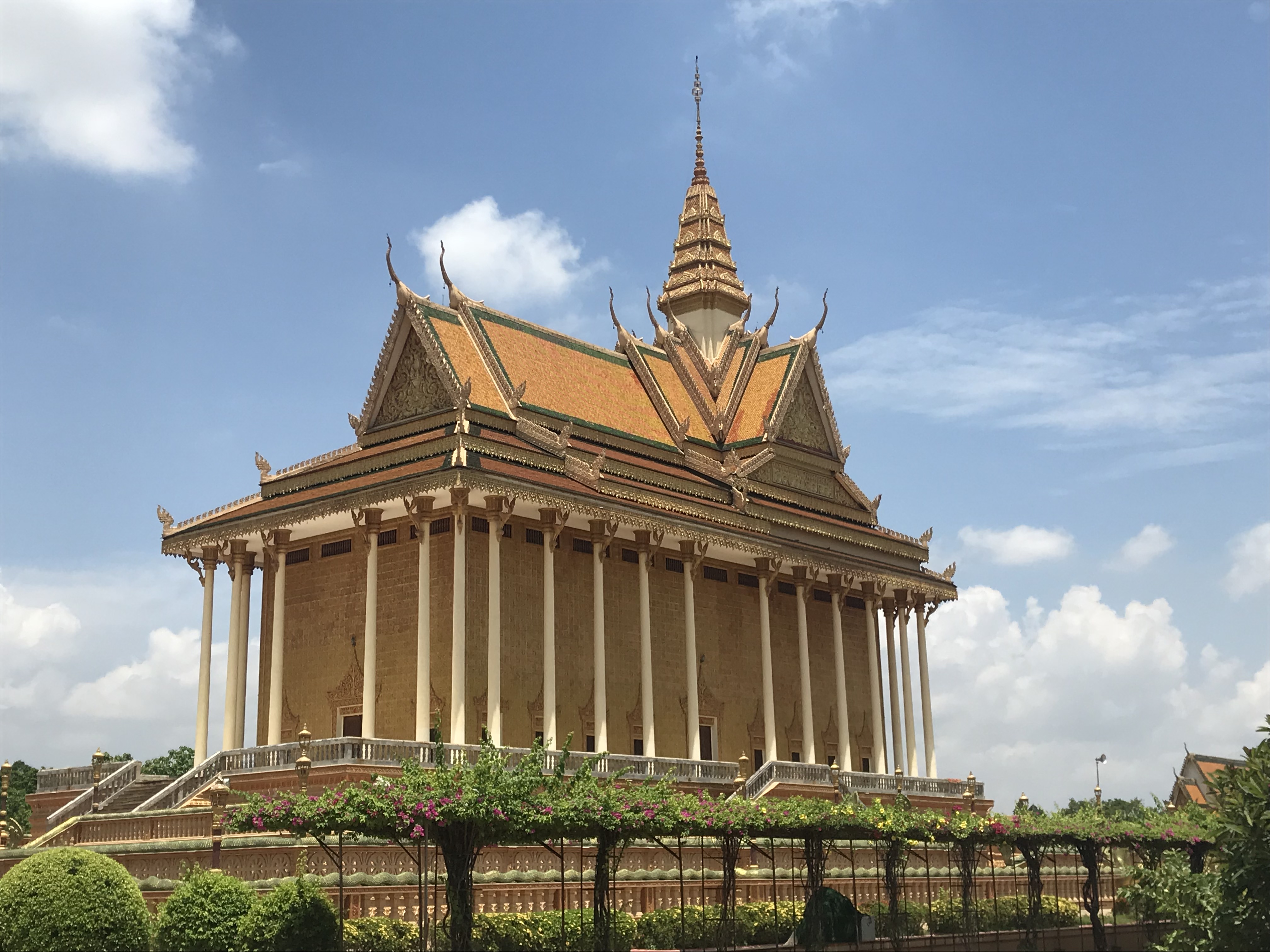
Most tourists travel to Cambodia by way of Siem Reap to visit the majestic yet mysterious ruined temples of Angkor, and rarely spend more than a day or two in Phnom Penh. That’s a shame, because, besides Phnom Penh’s notoriety for being associated with the brutalised systemic killings under the Khmer Rouge, in which visiting important sites such as the S21 prison and killing fields is a definite must in understanding its gory and savage past, this jewel of a place has plenty more to offer.
Phnom Penh is the capitol city of Cambodia and its most populous, with around 2 million people. Situated at the confluence of three rivers, the grand Mekong, the Bassac and the great Tonle Sap, it seemed like a natural place for a city to flourish. As any guide book will tell you, the city takes its name from the famous Wat Phnom Daun Penh (Wat Phnom or Hill Temple). According to legend, an old woman by the name of Daun Penh (or Grandma Penh), discovered five statues of Buddha floating down the Mekong and decided to save them by setting them up on a manmade hill 27 meters high. A temple was built in 1373 to house the statues so that people could worship them, and thus the city was established around this hill. In Cambodian language, Phnom means hill, and so Phnom Penh in literal translation means: the hill of Penh, and thus an appropriate title for this post.
Our hotel, OK Boutique (Address: OK Boutique Hotel – 174, street 19Z, Sangkat Chey Chumnas, Khan Daun Penh, Phnom Penh), was a pleasant surprise. With intricate wooden carvings on its facade and Balinese-influenced artwork in every corner, it looked like a Balinese resort on steroids. This massive 15 storey edifice juts out in the city skyline like a redwood tree in the middle of a desert. But the rooms were reasonably cheap – USD$133 for 4 nights for essentially a 4 star hotel, translating to around SGD$44 per day with breakfast thrown in – an unbeatable bargain. Highly recommended!


Day 1: The Royal Palace and a Tuk-Tuk Tour
We left the hotel bright and early today to tour the Royal Palace, just a stone’s throw from the hotel (literally speaking, as the palace’s compound wall was just in front of the hotel). The only problem was that it was the back wall, and we had to walk all around it to find the entrance. The fee was USD$10, and a guide lounging around tried his best to entice us to purchase his services for an additional USD$10. We declined, deciding instead to use the services of Google and my Lonely Planet guide. However, there was only so much information you can obtain online on the palace, and on second thought perhaps a knowledgable guide would have made for a better investment.

The Royal Palace is the official residence of the current King. The compound consists of many buildings, but several of them, at the time of our visit, were either closed off or under restoration. Compared to other notable sights in the region such as the Grand Palace in Bangkok, it isn’t as impressive, but it does retain its charm by not being overrun with tourists.

The Throne Hall is easily the most elegant building, with a gilded gold roof and a 59 meter tall tower inspired by the Bayon temple in Angkor. The interior is strictly off-limits as it is used mainly for coronations and ceremonies, thus it also contains the thrones of the King and Queen of Cambodia (because without them it would just be called…Hall).

Beside the Throne Hall is an eccentric iron pavilion, presented as a gift to King Norodom by Napoleon III of France in 1876 when Cambodia was under French rule. I had read about it in the guidebook and was dying to see it. It is currently functioning as an art gallery, but annoyingly the edifice was closed for renovation, hidden beneath metal scaffolding with large canvases draping over the frames depicting a printed image of how it is supposed to look like. You could tell at once that it didn’t looked remotely Cambodian. It looked more at ease sitting at a corner street in Paris or New Orleans.

The other noteworthy building is the Silver Pagoda (or Wat Preah Keo Morokat), situated adjacent to the Royal Palace, and housing a very valuable miniature emerald Buddha statue. It is called the Silver Pagoda because the floor tiles are made of silver. However, upon entering the building, we discovered that the floor was fully covered by a tatted carpet, thus the images of silver could only be evoked in our minds. The building bears an uncanny resemblance to the temple in Bangkok’s Grand Palace, which too houses a miniature emerald Buddha statue. However, this one was lighter in colour and more plasticky than its Thai counterpart, and whether it is genuine or not is a matter of debate (but don’t let the locals hear you say this).

The surrounding courtyard holds three impressive Stupas housing the remains of former Kings, and an equestrian statue of King Norodom, seeking shelter under a pavilion. The Stupas are painted white, but look shimmery under sunlight, hence I initially mistook them to be the Silver Pagoda. Another arresting sight is Phnom Mondop, a temple atop a small mount, supposed to resemble an artificial hill symbolising Mount Kailassa. It is surrounded by a jungle of trees and bushes so thick that they block out views of the temple itself, so that it resembles something like a ground-level tree house. You can’t miss it – it’s the only jungle in an otherwise concrete courtyard.

The other buildings weren’t interesting enough to write about, although there were some artefacts and exhibits on display just before you leave the compound, like a mock up of a wooden house on stilts (similar to a kampong), the royal saddles mounted on royal elephants (regal but uncomfortable looking) and a very very long human ceremonial procession for the prince during his coronation.

We left the Royal Palace and headed to Wat Oulanum, bypassing the National Museum because it was closed for lunch. The walk was unpleasant, as the roads were dusty, traffic was chaotic and the sun was scorching. However, entering Wat Oulanum was like stepping into tranquility. There was a cool breeze blowing and the shade from the temple provided a welcome respite from the heat. Wat Oulanum, founded in 1443, is the headquarters of Buddhism in Cambodia, though it had a less than tranquil past. The Wat took a beating during the Khmer Rouge when its head monk was killed by Pol Pot’s forces as an act of defiance against religious practices. The place is huge, comprising a total of 44 structures, although many of them are Stupas concentrated in the tightly enclosed compound behind the main temple.

Behind the building stands a gold Stupa, supposedly containing an eyebrow hair plucked (or dropped) from Buddha himself. Although the Stupa was closed, the caretaker, seeing us snapping pictures, volunteered to unlock the wooden door so that we could catch a glimpse of its interior. Inside, dark and dusty, were three Buddha statues, with a gaudy neon light frame hanging in the background like those used to attract customers into a seedy nightclub. Then he invited us to kneel and thrust a pair of joss sticks into our hands, beckoning us to bow to Buddha as a sign of worship, all the while showering us with blessings of holy water. Although a non-believer myself, I was moved by his gesture to bestow us with good blessings for our travels. We did as told, then stood to depart and, with a renewed feeling of wholesomeness in our hearts, left a small donation in the box for his kindness.

Outside, while lounging around, a tuk-tuk driver approached us and opened with this question: “Where are you from?”
“Singapore”, we replied.
“Oh, I have a friend living in Hong Kong”
We gave him a blank look, unsure of what to say next, thinking that he either had bad hearing, or was terrible in geography. However, he persevered, peppering us with questions and enticing us, as they often do when they see tourists walking the streets, for a tour of the city. Seeing that he had generated some sort of interest, he offered to take us to three places in the city for USD$35. A swindle, in my opinion. However, we bargained it down to USD$27, and although I was still hesitant, because nobody takes that much amount of money away from me without some serious persuasion, we eventually felt comfortable with his offer, but all the while I was certain that we were being cheated and that he would force us to stop at those tourist merchandise centers where they earn on commission.

Funnily enough, he turned out to be a really nice guy. He was a teacher at a school, and drove the tuk-tuk on weekends to earn some extra cash, and, unlike the thousands of other tuk-tuks that were zipping past onto incoming traffic, he drove very carefully. He even stopped to warn us about bag-snatchers and advised us to tuck our belongings safely between our legs. As it was nearly lunch time, we stopped at a nearby coffee shop across the Tonle Sap river, where we sampled some of the local food and cheap beer, in a local setting. The food was appetising; tangy chicken curry with pineapple, freshly grilled river fish and stir-fried green peppers with pork, washed down by cold Angkor beer.

With our bellies sated, we moved off to our pre-arranged succession of sights: first, Monkey Temple, so named because the temple is overrun with monkeys living in the nearby forest. This, too, had many stupas, but it generally looked more forlorn and dated. It also functions as a working orphanage. There were several resident monkeys loitering around in the shade, but most of them scuttled away when we approached, unlike the clutch of dirty-clothed orphans who ran to us and tried to be our friend, tour guide and interpreter all at once. We had a polite look around, handed out some dollar bills to the orphans, and departed. All told, there is nothing special about the place, and it doesn’t warrant a second visit the next time I’m back.


Next on, to the “Golden Temple” or Wat Kean Kleang, about 20 minutes away. Its main temple hall stood magnificently gleaming a long way off, covered in shimmering gold paint. Walking up a flight of steps to its entrance, you are flanked by rows of figurines grabbing onto nagas, an important symbol of Buddhism said to represent a guardian statue. Inside, the walls and ceiling are adorned with murals depicting the life of Buddha and the teachings in the Buddhist texts. As with most temples, it was very serene within. However, casually wander your eyes around the richly decorated walls and you’ll soon spot one or two images that leap out at you. For me, it was the rather gruesome portrayal of a person’s intestines pulled apart by savage birds.


Just adjacent to the Golden Temple is a supposedly 500-year old temple. I’ve forgotten the actual name of it, but the building is just across the road from Wat Kean Kleang, and beside a monks’ dormitory that, at the time of our visit, was getting a new roof. The temple was closed and deserted, but we could wander up to the outside terraces. Although the beautiful images on the wooden doors were badly fading, it is still very impressive and well-preserved. I liked it better than the Golden Temple for being a little more subdue in its looks. It also had an advantage of being located just beside the Mekong River, which we now made our way towards. The scenic river was peaceful, with overgrown bushes along the sides and long-tail boats in the distance rippling waves in the river as they drove by. It seemed like a perfect place to sit down in a deck-chair, with a bottle of cold beer at hand, and watch the sunset.

The next destination was Wat Phnom, the first temple in Phnom Penh, and Grandma Penh’s legend. We travelled back towards the city, crossing the Japanese-Cambodian friendship bridge spanning the Tonle Sap river, with a new one currently being constructed beside it. Throughout the journey, we breathed in blackened exhaust fumes from the traffic jam; our eyes and mouth stinging with bits of sand and dirt stirred up by the movement of vehicles on the road. Uncomfortable, yes…but we got to sample whatever Phnom Penh had to offer.

Wat Phnom sits majestically on a hill 27 meters high and is the highest religious structure in Phnom Penh, which shows you just how flat the place is. The entrance fee at a ticket booth was USD$1, and guides patrol the area to make sure you have your ticket in hand. The climb was worth the view; you could see the sprawl of the urban city in all directions. Behind the main temple building stands a Stupa, and there is a small shrine to Grandma Penh for worshippers to leave flowers and incense.


Our last stop for the day was the National Museum (entrance fee USD$10), itself touted as one of the best places housing Khmer art, sculptures and artefacts in the world. Located just in front of our hotel and beside the Royal Palace, its terracotta style structure reflects the traditional architecture of the country. It is a handsome building, one that is less grand but no less impressive than Throne Hall. Some of its turrets were cladded in scaffolding, marring my attempt to take picture-perfect postcard photo.

Within the museum contains four main sections outlining the various periods in Cambodian history. In the first section were artefacts of religious nature, like figurines of Vishnu, when Buddhist culture was seemingly intertwined with Hinduism. Don’t ask me more on the details, as I was quite tired from the day’s exploration and museum fatigue set in pretty darn fast. What I remember most were the large and intricate friezes salvaged from the Angkor temples before destruction, as well as the towering statues of gods, princesses and other deities made of stone. What I liked best, however, was the very inviting courtyard, with its neatly trimmed scrubs, flowering trees and reflecting pools full of carp, that made the place retain an air of tranquility amidst the bustling city. It was a very congenial place, where local children gathered to feed the fishes in the pond while old men doze off along the benches of the lobby entrance. It’s a definite must-visit place on anyone’s itinerary.


Dinner, and we headed to a well-known chain called Friends the Restaurent (address: #215 Street 13, Phnom Penh, Cambodia), which not only cooks authentic Cambodian food but also helps to keep young locals off the street by offering them a stepping stone to hone their culinary skills. A noble practice, considering that many impoverished orphans were left to fend for themselves after the Khmer Rogue killed off their families. Many of them join the monastery, where they receive food and shelter, but places like these help them achieve their dreams. We sampled their classic dishes: crispy zucchini and cheddar fritters to start, hearty Burmese curry noodles, and roasted pork belly with a fresh green mango salad, washed down by their fresh fruit juice concoctions.


Thereafter, we took a long walk along Sisowath Quay to the night market, braving the annoyingly on-again, off-again drizzle. It eventually opened up into a torrential downpour, forcing us to take refuge in a touristy bar with bad music and even worse bar snacks. After finishing a pitcher of Cambodian beer and realising that the rain had subsided, we took to the streets again, arriving at the night bazaar well after 9pm. It was a downer, as there was nothing much to buy because the fashion apparel on sale could only appeal to Cambodians and no one else. There was not much in way of souvenirs as well, mostly pirated merchandise of DVDs, LV wallets and CK belts. It was however, a nice place to mingle with locals on a weekend night. The night market opens from 5pm – 11pm.

The only charming section was the food market, with stalls selling salads, grilled meat and juices surrounding a wide space lined with mats, where families would sit and order food from whichever stalls they fancied. It resembled a poor man’s version of Marche. Feeling peckish, we stumbled upon a coconut ice-cream dessert stall. It was similarly underwhelming, like the night market. The coconut shavings were too tough and bland, while the ice-cream was the usual Walls brand. To be fair, the market was an interesting place to see locals at play, but had nothing to offer to the tourist hungry for a memorable experience.

Day 2: S21 Prison and the Killing Fields
We had a long day ahead of us today. We were going to explore the more gruesome side of Phnom Penh: that of fields of blood and buildings turned into prisons. Today’s itinerary would no doubt be that of horror, pain and mournfulness, and the silent reflection on the cruelty and viciousness of mankind.
After having an early breakfast, we caught a tuk-tuk outside the hotel to the Choeung Ek Genocide Museum, better known as the killing fields. The driver offered us a package to see the killing fields, S21 prison and Russian market, for the price of USD$30. The killing fields, perhaps most synonymous with Cambodia other than Angkor Wat, is situated about 23km away from the city centre. We lumbered along back roads, passing verdant palm trees, rice plantations and tiny villages with barefoot children running around. All around there was a peaceful silence, punctuated by the laughter of children, and the occasional rumbling of a truck. It’s quietness seemed to belie a savage and violent past
During Pol Pot’s regime, many killing fields sprung up, just like the one at Choeung Ek. However, these were located further away, or were not easily accessible to tourists, or still covered in mines. All were used for the systematic slaughter of anyone opposing the regime: intellectuals; foreigners; people with disabilities. Altogether, some 20,000 people died at Choeung Ek, but around 3 million more perished in other sites. Passing the main entrance (USD$6 with audioguide), we were given a very informative audioguide, with a signposted route to follow.

The regime’s method was brutal, strangely meticulous, effective. Prisoners would arrive in the dead of the night on the back of trucks, blindfolded and handcuffed. They would then be processed, their particulars noted down and systematically documented (kind of like how the Nazis did in their concentration camps). They would then be interrogated, and finally bludgeoned to death with whatever tools were available, such as iron rods, spades and crowbars. Bullets were used sparingly, because they were expensive. A particularly cruel yet ingenious way to kill them was using the razor sharp edge of the sugar plant leaf to silt their throats. This action was done after the victims had been bludgeoned in the skull, to ensure that they were indeed dead. These killings were done in the middle of the night, with loud speakers blaring the regime’s propagandist messages to drown the screams of its prisoners. As a result, everyone in the vicinity thought that Choeung Ek merely served as the party’s meeting place, and no one was aware of the brutality that took place within.
Walking around, you’ll see mass graves roped off by a rope fence, the graves sunken into the ground and covered in weeds and grass. Occasionally, glimpses of fabric can be seen partially covered beneath the sand. Most notably, the walk included a mass grave containing the headless bodies of 166 (the most found in a single grave) “enemies of the state”, a mass grave containing the naked bodies of slain females, and the killing tree, of which babies were smashed before they were hurled into the open pit. It was hard to swallow, made more poignant by the fact that the audioguide and signposts did not mince words. In a glass box at the far end of the field, victims’ clothes, shoes and other personal items were collected. Another box contained their bone fragments, and someone must have recently discovered an entire jawbone in the ground, for it was placed neatly on the top of the box.


Behind the graves is a large pond containing the bones of the dead, but in an effort to not disturb their remains, the pond was not drained. It provided for a calming walk after the rather macabre surroundings. At the last signpost, stands a towering memorial Buddhist Stupa, one of the most famous icons of Phnom Penh. Inside houses, on 19 levels, 5,000 pieces of bone and skull remains of the bodies who were excavated from the pits. You take your shoes off and step into a very tight space within the ground level, coming face to face with more skulls than you care to see in your lifetime, all neatly lined up in rows of 10 – 15 across. Coloured stickers placed on the skulls illustrate the different ways in which the victims were killed, but most featured gaping holes or splintered skull fragments.


Don’t forget to go down the road to the small museum just before exiting the genocidal center. It illustrates, in the form of informative wall panels, the history and party members of the regime, as well as stories of how victims were executed. There is also a small video room where they play a short, poorly recorded video on the Khmer Rouge and the discovery of the killing fields by local farmers. Most of the party members, it was mentioned, went away scot free. Only the top ranking members were hauled to an international court tribunal, but the slow process meant that most of them would die of old age before they could be sentenced. It was a poignant reminder that sometimes justice didn’t always prevail in the world.
Leaving the place in a dull frame of mind, we next headed to the Tuol Sleng Genocide Museum (aka S21 prison), which was a former high school turned concentration camp. It is located in the heart of high-rise apartment complexes, and occupies four large blocks bordering a courtyard. The air here was still, heavy, and once again you could see the pained and silent contemplative reflection in the faces of the tourists as they peered into the peeling classrooms through wooden doors and broken shutters. Although the facade of the building was drab and dreary, the tiles were actually quite retro, giving the building an injection of colour and life.
You start at Block A, looking into actual classrooms which functioned as cells to interrogate prisoners. In each cell, a lone bed frame, rusted and dented, is placed in the middle, with an accompanying photograph showing the unfortunate person who was tortured on it. Nothing was censored (only the face); the evidence of torture is laid bare for all to see, and that was kind of hard to take in. Amazingly, there were patches of dark stains on the floor below the bed: blood soaking through the tiles. Some tiles even buckled after soaking up so much blood, causing the floor around it to sink into the ground. After all these years, it looked as though someone had only came in with a mop to wash off the actual blood.


You go on like this for 3 other blocks, except in the second block, there are photo IDs of prisoners who passed through the gates, all taken in black and white with a number ID pinned to their collar. Although most of their expressions were sullen, some of them were smiling, perhaps unaware of the fate that awaited them. The more disturbing pictures showed actual dead bodies in the prison itself, taken by a photographer when the prison was liberated; its hard not to look away. There were also other interesting stories of unlikely romance that ended in tragedy, as well as anecdotes on the daily life inside the prison and the types of torture imposed on the prisoners. Cell block C was the most forbidden looking of them all, with rusty barb wire plastered across all the open areas to prevent prisoners from committing suicide and thus dying prematurely before being tortured.

During our visit, we had the chance to meet two of the surviving prisoners, a rarity since most of them died in there. They were selling books, no doubt trying to make a living from telling their tales to tourists. I bought an autographed book from Bou Meng at USD$10, a small price to pay considering that he was the last few of the survivors and wouldn’t be around much longer. He was very kind, all smiley and gracious to take a photo with us. According to what I presume to be his son who took the photo, Bou Meng was spared because he could draw, and he drew a very good and accurate picture of the Dictator, Pol Pot, which somehow saved his life.

With such a depressing morning and early afternoon, we looked forward to a hearty lunch to lift our spirits. A nearby restaurant called Eleven Kitchen, which boasted a nice relaxing ambience and good local food, was recommended. Well, we weren’t disappointed. We had a refreshing glass of coconut shake, and shared two dishes: the famous signature dish of Cambodia – fish amok – a kind of spicy yet flavourful fish curry steamed in banana leaf, and one of their set lunches consisting of fried pork with pineapple and a vegetable curry.


After lunch, it was a short ride to the Russian market, or Toul Tom Poung Market, so named because the predominate Russian expat population used to shop there in the past. This was like a miniature version of Bangkok’s Chaktuchak market, with many small stalls selling imitation clothing, jewellery, souvenirs, food and even pets. The shops crowd around narrow, hot and humid alleyways; the sort where if you stop at a stall to rummage for some merchandise you’ll end up clogging the entire alleyway. We hunted for clothes and souvenirs, but none caught our fancy, though we did stumble upon a sundry dried fruit shop that sold preserved candy mango slices, peanuts and other types of dried fruit. We bought some dried mango slices (sealed in vacuum-locked bags) and an interesting species of cashew nuts that had edible shells for around USD$5 per kilo. Oh, and it’s a good place to practice some hard bargaining as well. There is also a market cum hawker food stall all the way at the back, but these were mostly closed by the time we got there. Another food adventure saved for my next trip!

Tired, we headed back to the hotel, where our tuk tuk driver casually asked whether we would be interested to see a muay thai match down at one of the boxing rings in the evening at 6pm for free! However, the ride there would cost us USD$12, as it was way out of town. This seemed like such a good opportunity that we accepted, and after an inviting shower and change of clothes, we climbed aboard and headed south of the city.
It was just approaching 6pm when we fought through the crowds all lined up outside the stadium. The ride took around 40 minutes. The driver led us to a side entrance, and upon indicating to the guards that we were tourists, the gate was slid open. Apparently, tourists get to watch for free and could sit in the VIP section, whereas locals had to pay and squeeze in to find a standing space in the already overcrowded arena. Our driver, no doubt, was very happy, for he could watch the match for free and get a seat. The air was thick and hot with sweat and anticipation, and the crowd was on edge, much like English soccer fans at a football match. It was some big match in Cambodia and it was beamed live onto local TV. A presenter, facing a camera, rattled on in Cambodia, rallying the crowd and making them laugh. It was a surreal experience. You could almost imagine a riot breaking out in the arena if their Cambodian favourite lost.


We were near the ring, and our seats afforded us a very good view of the match, save for the strips of advertisement banners that hung on the ropes. There were 3 matches in total. In between, the in-house DJ spun local tracks, working the crowd into a frenzy, causing them to nearly spill open the barricades that were holding them back from the ring. The ferocity of the matches (and the crowd’s spirits) was a slow and steady build up to the last match, Cambodia versus Cambodia. One boxer was, presumably, the crowd favourite, for they cheered and clapped every time he succeeded in getting a punch out, while the other was “the bad guy”, who really didn’t elicit much response from the crowd. The bad guy fought on doggedly and relentlessly and won by a narrow margin. It was a good fight and, in my opinion, he deserved the title.
However, the biggest fight of all had to be our tuk tuk driver versus the thousands and thousands of people trying to leave the arena at the same time. We squeezed and rubbed shoulders with all the locals beside us. Traffic was almost at a standstill, but we managed to break free and were on our way back to the hotel.

We arrived back safe and sound, famished but filled with excitement. We walked down a few blocks to Frizz restaurant, and had a very full meal consisting of fish amok (now Amos’ favourite must-have dish for every meal), prime beef lok luak (a sautéd beef with sauce – apparently a Cambodian classic), and a rich, stewy Khmer vegetable soup, a little unusual because it had vegetables AND fruits in it. But the meal was good; the only complaint was that the place was so dim it was almost hard to read off the menu. Our bellies full, we trekked back to the hotel, recounting our experiences. It was a tiring but very productive day!
Day 3: Day Trip to Udong
We had slotted in a free day today, to take in a day trip to explore the outskirts of the city. I think planning free day(s) in the midst of your holiday is a must, as every day is packed with schedules and timetables and you are hopping from one place to another with barely enough time to take a step back and relax. It’s good to have a day off to chill in a cafe and people-watch, or spend the day idling with no particular agenda in mind. At the very least, it makes you less tired after your holiday!
Such it was the case that after breakfast, we asked the same tuk tuk driver what he recommended we’d do. After much back and forth, he proposed Udong Hill, a religious site steeped in history, about 2 hours out of Phnom Penh. We agreed, clambered aboard and began the long, dusty trip out of the city. The drive was one of sights, sounds and smells. Drive pass grasslands and you smell the wonderful aroma of grass and flowers in full bloom; pass repair shops and it changes to motor oil and grease; pass villages and the stench of raw sewage and garbage hits you like a wall.
The scenery was amazing, with padi fields and small, ramshackle villages on both sides of the paved highway stretching as far as the eye can see. It must be said that the region around Phnom Penh is breathtakingly flat. We could see Udong Hill a long way off, with its Stupas on the peak gleaming white in the late morning sun. We paid a USD$1 entrance fee (for tourists) to enter the village, and then the driver stopped us beside a battered pathway that wound up to the base of the stairs.
Udong (or Oodong) Hill is located some 40km northwest of Phnom Penh. It was the former capital of Cambodia before being relocated to Phnom Penh by King Norodom in 1866. Udong was the site for the coronation of past Cambodian Kings, and now their ashes are entombed within the Stupas dotting the peak. We trekked up a short but steep path, and entered a courtyard with several badly-weathered stupas dating back to ancient times. Nearby stands a memorial dedicated to the victims of the Khmer Rogue regime; within it contains the bones of hundreds of people found in mass graves around the area.

Facing the peak, we lumbered up the 500-odd stairs, passing a few beggars along the way. It was a pleasant walk despite the scorching sun, as the path was lined with trees and provided ample shelter. At an opening halfway up the hill, we spied a troupe of monkeys taking shelter and drinking water from an open well. The monkeys were surprisingly unafraid of us, and paid us scant attention while we took pictures. However, they started to become aggressive after we made the mistake of going close to them for a photo op. Not wanting to be chased by the horde all the way down the hill, we left them in peace and continued up. Upon reaching the peak, we were greeted by an awesome sight: a shiny, intricately crafted temple Preah Sakyamoni Chedi, built in 2002 to house an eyebrow hair relic from Buddha. Naturally, it was closed, but the views of the countryside from the temple courtyards were spectacular.

We took some time to soak up the panoramic 360 degree views, and snapped some postcard-worthy pictures. This would have been an ideal location to admire the setting sun. The horizon stretched out as far as we could see, greenery interspersed with the brown blotches of straw roofs. We were the only two tourists here, and it was magnificent.


We headed to the back of the temple, to where older stupas stand. These were less impressive, but no less significant, as they housed the ashes of former Kings. One of them stood out by incorporating a distinctly Angkor design of having four faces of Buddha on its spire. We spent a happy half an hour poking around the makeshift drink and food stalls, some equipped with ice-shaving machines, and wondered who was the unfortunate soul who had to carry ice blocks all the way up here.


We next explored the massive temple complex that was the Udong Monastery. There were several living quarters, a giant reclining Buddha (but smaller than the one in Bangkok), a large pool with a very mossy-covered naga and a towering main temple that looked just about 4 stories high. Unfortunately it was closed, but I had read that it was very beautiful inside. We had a long look around, and eventually stumbled onto the second floor of a smaller shrine, but first removing our shoes at the entrance. It was so quiet and empty that our arrival startled the young monk who came out to sweep the floor. Deserving a good rest, we sprawled across some chairs and read up about Udong, all the while careful not to wake another, more elderly monk sleeping on a bed in the balcony. When we decided to leave, we realised that our shoes had been neatly arranged to one side with the tips of our shoes facing out. Such excellent hosts!
Besides the pleasant encounter, the walk around was uneventful, although I did manage to take a picture with a very frightened looking girl.


We left Udong and began our 2-hour journey back to the city. On the way, we asked our driver to stop at the famous Central Market, clearly observable by its huge Art Deco yellow dome. It has four extended wings selling everything from sunglasses to electronics, bags and souvenirs to food and drinks. It was built by the French back in 1937 and was the largest market in Asia when it opened. Although the sun was scorching when we alighted from the tuk-tuk, its cavernous interior was surprising cooling. We shopped for pirated sunglasses (Oakleys at USD$10; mine snapped a week later), elephant-printed bags and other small souvenirs. It was fun bargaining for items. The sellers weren’t as fierce as the ones in Chaktuchak Market, and they were more willing to match your price. Still, there is always a bottom line, and they would likely turn to another customer if they felt that they couldn’t get you to bargain fairly.

To cap off a rewarding day, we headed back out once we had dropped off our things in the hotel, and took a long walk in the other direction towards the new swanky Naga World, an amusement park and shopping centre south of Sisowath Quay. However, we were side-tracked by the towering Cambodia-Vietnam Friendship monument, built by the communist government in 1970 after the Cambodian-Vietnamese war. A few hundred steps down, in the middle of a busy square in the middle of an even busier thoroughfare, is the Norodom Sihanouk Memorial, a statue of the former king standing proudly on a pedestal. Norodom died in 2012, and his son ascended the throne as the current King of Cambodia. It made for a nice background in the early evening.


We decided to try out a famous restaurant nearby, known as Malis (36 Preah Norodom Blvd (41), Phnom Penh 12301, Cambodia), which served local authentic Cambodian fare with a twist, set in a tranquil, resort-like environment. Upon entering, it looked pricey, but since it was our last day in Phnom Penh, we decided to splurge and treat ourselves. We ordered the local grilled sausages, which were spiced with chilis and oily from the fatty meat, fish amok and an interesting grilled eggplant, which had great taste but had the consistency of baby food. Our drink of choice? Beer, of course!


We took a long stroll back to the hotel, passing the Independence Monument along the way, basking in the glow from spotlights in the middle of a busy roundabout. It was much nicer now: the sun had gone down, and the open spaces of the squares surrounding the monuments were very inviting. The air was cleaner and the public areas were teaming with locals, playing soccer or brisk walking. Beside the friendship monument, someone had set up speakers and a console to DJ, and people were relaxing on the ground chilling. There was probably an event going on at the square where King Norodom’s statue was located, as thongs of people were walking around it in a counter-clockwise direction. We first started out against the human traffic, but we soon become uncomfortably aware that we were the only two people walking against the flow, and decided to change direction. It meant walking a longer distance back to our hotel, but at least we were at peace knowing that we weren’t interrupting some unknown forces of the universe at work.
Day 4: North Phnom Penh and Raffles Hotel
It was our last day today, and we headed out bright and early up north of the city to take in views of the remaining French architecture harking back to the time when Cambodia was a French colony. The buildings were beautiful, with intricate balconies overhanging the 1st floor shops, and they had aged gracefully, not like the colonial buildings in Yangon that had fallen into disrepair. Our legs were refreshed (somewhat) from a 2 hour long massage we did last night near our hotel, in a spa-like shop with posh, Balinese deco. However, we spied a blind massage parlour (USD$10 for 1 person) along the way and decided on impulse to try it. It was rather good, but since I don’t enjoy massages in general, my opinion doesn’t hold any weight, but my friend was very happy with his and gushed that his massage was way better than the previous night.
On the way we spotted short procession of monks on their daily morning routine to beg for alms. This process was, to me, such a generous reciprocity of good intentions, and one that reinforced each other’s goodwill and charitable nature that is a cornerstone of the Buddhist culture. Monks, on one hand, take to the streets to seek offerings from locals in exchange for prayers and blessings. Locals reciprocate by receiving these blessings and offering, by way of thanks, money and food. Monks generally do not determine how much food they would like to receive, and do not demand for more. Locals, on the other hand, are grateful for the blessings received, and try to repay by offering more food and money. It just seems like such a noble arrangement; based on respect, humility and the yearn for good karma. If this was dropped into a capitalist setting, monks would put a price on their blessings by demanding for more food or money, and locals would bargain for more blessings while offering little in return.

On that interesting note to chew on, we continued on with our sightseeing adventure, heading straight for Phnom Penh’s stately Central Train Station. I wanted to take a look at it just because I like trains. However, the station and its platforms were disappointing empty, as passenger trains stopped plying from the station since 2014, and it was chiefly used for freight.


Next, we headed down to the famous Raffles Hotel Le Royal, an opulent and historic 1930s “pearl of the orient” with heavy French architectural influence, as iconic to Phnom Penh as the Raffles Hotel in Singapore and the Strand Hotel in Yangon. The Raffles Le Royal was the place back in the 60s, when famous celebrities and royalties such as Jacqueline Kennedy and Charlie Chaplin stayed there. It was also the film location for the movie The Killing Fields, playing the role of the last bastion before journalists had to flee because of the Cambodian civil war that led to the start of the Khmer Rouge regime. It’s a must-visit institution.

After admiring the pleasant beige facade, we entered the cool, stylish lobby, half afraid that we would be thrown out on account of our sweat-slicked t-shirts and shabby appearance. The interior was like a throwback to the 1960s, with ornate cornices, cushy sofas and heavy on the wooden furnishings. We walked around, admiring the deco. The pool looked so inviting that we were half contemplating to dive straight in. But we had a flight to catch, and there was little time to lose.
Upon leaving, we decided to try booking a Grab tuk-tuk, a novelty to us Singaporeans. It made use of the same app, and there was an option to pay in local currency or credit card. Tuk-tuks are frequently used by tourist and locals alike as they provide a cheap and convenient means of transportation. However, most of them are carriages attached to motorcycles, and are frequently underpowered. The Grab tuk-tuks were newer models, based on the traditional tuk-tuk models in Bangkok.

We took the tuk-tuk back to our hotel, packed up our stuff and checked out. The hotel’s tuk-tuk could do a run to the airport for USD$8, way lower than the taxi, and we decided to use that instead. On the way, the skies opened and our shoes and pants were drenched. However, it provided such a welcoming relief to the heat that we didn’t much mind. We checked in at the airport counter and grabbed a bite at the departure lounge’s cafeteria, refusing the allure of Burger King and going for local cuisine instead, fully indoctrinated as Cambodians. We sampled the fish amok and beef lok luak, but naturally, it wasn’t as nice as in the city. We boarded soon after.
As the plane pulled into the clouds, it banked slightly, dipping its wing so that I could sneak a quick peek at the flat expense of landscape that was our home for the past four days, and knew that I would come back again.
