Walk I: Today’s walk follows the canals of Rattanakosin Island. Begin at the majestic Democracy Monument, then hop over for breakfast at a local favourite, Mont NomSod. Later, explore the iconic Giant Swing and Grade I Temple of Wat Suthat, before indulging in brunch at Jay Fai, a one Michelin-starred eatery. End the walk with a visit to temples along Maha Chai Road before climbing up the Golden Mount for breezy views over Bangkok.
Rattanakosin Island may not be a familiar term to most visitors; but mention its star attraction – the Grand Palace – and people immediately understand. This post, however, does not include the Grand Palace since its stories have already been told countless of times, but seeks to discover the other hidden gems that are concentrated within this 3 square kilometre of prime real estate. (Photo of Wat Saket at night – credits to iStock)

The island was created after King Phutthayotfa Chulalok (or Phraya Chakri, depending on the time period), styling himself as Rama I, shifted the old capital from Thonburi on the western bank of the Chao Phraya, to the east, on which occupied a small village called Bang Makok. If you had read my previous post, the growing importance of this new capital was postulated to have given rise to the city’s modern name, Bangkok.
Bang Makok was originally a swamp, and so Rama I ordered the draining of marsh water and the construction of fortifications, walls and moats to safeguard his new city. Having relocated the original settlers further downstream to what is now Chinatown, Rama I then established the first city pillar near the Grand Palace at the precise time of 6:45am on 21 April, 1782.
To get a sense of our bearings, Rattanakosin Island borders the Chao Phraya river to the west and a series of small moats and canals to the east. To the south is Chinatown (or using the more correct term, Yaowarat Road) which is a blog entry by itself, and Krung Kasem road borders the eastern canal, which also runs along Bangkok’s former railway terminus at Hua Lamphong.

Further in, Maha Chai road runs parallel to a smaller canal that flows out to the Ong Ann Canal, itself a picturesque walk and featured in my upcoming Yaowarat and Talat Noi post.
But first, let’s start at the big winged structure called the Democracy Monument. Like the Victory Monument, it stands in the middle of a busy roundabout and commemorates the 1932 Siamese revolution, which led to the establishment of a constitutional monarchy in Siam, the precursor to modern Thailand. Its four winged pillars represent the four branches of the armed forces that carried out the revolution, and they surround a boxy structure that contains the 1932 constitution carved on palm leaf, on which sits two bowls of offerings. When it was constructed in 1940, it caused a lot of displeasure amongst residents as they were required to be evicted in a short period of time. Furthermore, the widening of the roads also resulted in the uprooting of shady trees, thereby making the area unbearably hot. It seems ironic that a structure symbolising the ideals of democracy could be undemocratically constructed using a heavy-handed approach from the country’s leaders.

Around the roundabout stands Rimkhobfa Bookstore, with a gigantic map of old Siam plastered to its window. It’s worthwhile to head down the adjacent Dinso Road for a spot of breakfast at a popular cafe frequented by locals – Mont NomSod (daily, 1pm – 10pm). It was started in 1964 by Khun Mont, who started life as a travelling pushcart selling freshly baked pastries and milk. Such was its popularity that he founded this first shop along Dinso Road which continues till today with the tradition of selling his famous homemade bread with spreads, pastries and milk. It has since expanded to include three more shops around Thailand.

Some of the more popular spreads include the brown and pandan coconut custard (or kaya), thick milk chocolate, and also creamy and sweet condensed milk. NomSod usually lathers it thick on a soft, grilled slices of white toast. The spreads are of a custard consistency and deliciously creamy, and they pair perfectly with their locally produced milk.

Besides ordering freshly grilled toast from the busy counter, there’s also a counter that sells baked bread slices, pastries, jars of coconut custard and cakes to take home. However, it seemed quieter than the sale of baked bread and spreads, whose items moved very quickly off the shelves by the constant stream of customers.

Venturing a little further down Bamrung Mueang Road, one comes across shops selling Buddhist supplies and paraphernalia, including alms bowls, bells, candles, saffron robes and Buddha figurines. One of the store front even had a life-sized wax statue of a monk, sitting in the lotus position and looking as though he could at any time stand up and walk. It was that realistic – down to the skin blemishes, liver spots and veins along the arms.
The large white building on the left is the Bangkok Metropolitan Administration City Hall and in front there’s a large square called Lan Khon Mueang which on occasion hosts festivals and bazaars. A short jog right along Soi Lang Bot Phram is the Gingerbread House (11am – 8pm, opens earlier on weekends), a cosy cafe with art deco construction and design that serves delicious baked goods and Thai desserts accompanied by artisan coffee products. Back on Dinso Road, a short walk down is the Devasathan (Brahmin Shrines), featuring individual shrines to Shiva and Ganesh amidst a beautiful and well kept garden.

In the distance, a religious structure called the Giant Swing pops into view. Standing at 27 metres tall, its striking red structure with an elaborately carved roof is visible for miles around. The Swing, originally constructed in front of the Brahmin Shrine in 1784 just after the founding of Bangkok, was later moved to the current location in the 1920s. It was a prime target for lightning strikes since its construction, and it has undergone several restorations, most recently in 2007.

But why a Giant Swing? In the former Siamese Empire, Hinduism and Buddhism were closely intertwined, such that when the local Brahmin named Kratai asked permission from King Rama I to build a temple and a ceremonial swing to carry out Brahmin ceremonies, the King readily agreed. As part of Brahman tradition, followers believed that the Gods Shiva and Vishnu descended from heaven to earth once a year, and that it was considered good luck to celebrate their arrival with ceremonies, including the swing ceremony. To give thanks for a bountiful of rice harvest and ask for blessings, young devotees in elaborate headdresses would climb onto the swing to be launched into the air so that they could catch a sack of coins, positioned on a pole 25 metres away, with their teeth. This practice sounded like fun until it was discontinued in 1935 after a couple of devotees missed the mark and fell to their death. They probably reached enlightenment at that single moment when they realised the shortfall in distance from the sack of coins. I would.

Facing the swing is an enormous temple called Wat Suthat (daily, 8am – 5pm, 20฿) a royal temple of the first grade and only one out of ten in Bangkok. It is the main factory that produces and supplies priests and monks for temples throughout the country.

Its name derives from the Hindu mythology of Suthatsa Nakhon, the celestial city of Indra which sits at the top of Mount Meru, the centre of the universe. One of the first temples in the city, it was constructed in 1807 by Rama I and completed by Rama III in 1847. To churn out such a large group of monks, Wat Suthat covers a large piece of real estate with many rows of dormitories and classrooms, and it also has the longest ordination hall at 72 metres.

In the ubosot, a Buddha image called Phra Sri Sakyamuni (usually a three dimensional figure made of wood, stone or metal) once hailed from an abandoned temple in Sukothai; it was discovered and floated downriver to this temple to be installed. Rama I was said to have personally helped carry the image from the pier and also joined the procession to the temple. He was unwell at that time and soon died after its installation, whispering to his assistances that his work was complete. The complex is extremely large and it is a pleasant place to wander around and watch the young monk trainees in their bright saffron robes meditating in the prayer halls.

For an unusual sightseeing experience, the nearby Rommaninat Park down Unakan Road is an incredible oasis of green in this old city. It has an outdoor gym, sports facilities such as a basketball court, and a playground. The public park is usually lively with locals brisk walking, lolling on the benches and exercising at the small but decrepit gym. Around the park are old circular watch towers, painted cream with a brown roof, evoking a forgotten era of the former Klong Prem prison. This was Bangkok’s central prison before it was shifted to the Bang Kwang Central outside the city. It opened in 1890 and closed around 1990, and was modelled closely on the prison layout in Britain. Most of the buildings were demolished and only the offices, a cell block and several watchtowers remained.

Making a roundabout at the park, walk up Maha Chai road and there are a few art galleries, eateries and cafes lining the street. At the intersection between Maha Chai and Bamrung Mueng road, the area where the Sommot Amon Mak Bridge passes over the canal was once known as Pratu Phi or “Ghost Gate”, formerly one of the gates in the old walled city of Bangkok in which the deceased were carted off to be cremated.
Further along this road is Raan Jay Fai, a small and seemingly inconspicuous corner eatery. However, early in the morning a patient and orderly queue – consisting mostly of tourists – starts forming; a testament to the popularity of the place. It isn’t just the food that they are waiting for, they are here to see a famous celebrity chef in action.

She is seated in a chair away from the kitchen, wearing her trademark blue latex gloves and goggles, with the air of someone who has knows the art of showmanship.

This is the legend of Jay Fai, one of the first coffeeshop-styled one Michelin star eatery featured on the Netflix series, “Street Food Asia”. She is often pictured cooking, with elaborate care and attention, on her blackened cast iron wok over a roaring charcoal fire.

Her speciality? The crabmeat omelette – thick and juicy chunks of crab meat ensconced in an egg omelet, fried golden brown and carefully presented on a bed of lettuce, looking like a golden pillow. At 73 years old, Jay Fai, now a Netflix superstar, is still feisty and energetic, and also a perfectionist, for she cooks every dish by herself. With just eight tables inside and a few on the pavement, waiting times at this cosy restaurant can stretch up to three hours.

Jay Fai doesn’t accept reservations online (at least when we were there in 2021), and therefore the only means to secure a table is to get there early to queue. Out front is a name list for customers to write down their name beside a queue number. Staff would call out these numbers and cross out the names down the list, and once all the party was present, you were handed a menu for ordering.

Back then, during our virgin experience, we ordered two freshly-squeezed orange juice, the famed crabmeat omelet, stir-fried drunken prawn noodles, and a tom yam soup. The omelet was just as we imagined, golden brown and bursting with succulent chunks of crabmeat. The prawn noodles were tasty with fish sauce and blackened with wokhei, or breath of the wok, but the soup was disappointingly normal, even though it had large chunks of fresh fish. Overall, it was a good first experience, but the meal was very expensive (S$40 for just the omelet with the meal coming close to S$100)) by Thai coffee-shop standards.

However, if you do want to try it, here’s a trick to minimise the wait: come early before it opens and write your name down on the list – hopefully you will be early enough for the first or second sitting. Hang around until your name is called, which should take about 1 hour. They do not take reservations for tourists, but locals can probably book directly with the staff. When the list is full, a sign saying “Fully Booked” will be placed at the counter. This is done to ensure that Jay Fai herself is not overwhelmed with orders. Once the list has cleared, the “Fully Booked” sign is removed and a new list is placed out.

For something equally tasty and popular, without much of a waiting time, try Thipsamai‘s (daily, 9am – 12am) Pad Thai.

This famous Thai dish is infused with fragrant shrimp-oil and crunchy beansprouts, and served as is, or accompanied with two large pieces of fresh deep-sea shrimps. It is located just a few doors down from Jay Fai and although crowded, the queues move fast.

Nearby is a cluster of temple buildings, and the road leading into that, Soi Samran Rat, follows a long and narrow cluster of small shops, darkly lit and smelling of incense, selling Buddhist supplies: wax figures of monks, amulets and prayer beads. Beside this is Wat Thepthidaram Worawihan, a third grade Royal Temple founded by Rama III for his eldest daughter, Princess Vilas, and it is the only temple honouring female monks, or bhikkhunis, of which Thailand does not have due to the monastic requirement (and circular argument) that a new bhikkhunis can only be ordained by five male and five female monks. However, due to its association, it is sometimes referred to as the Angel’s Temple. Although constructed in 1836, it has since been refurbished over the years, and it is famous for once housing the Royal Poet, Sunthorn Plu (whose bronze figurine we saw along the Chao Phraya riverside on Part II of my post on Thonburi), during the Rattanakosin era. In the ubosot, the principle Buddha image is carved from pure white stone and known as the Venerable White Buddha.

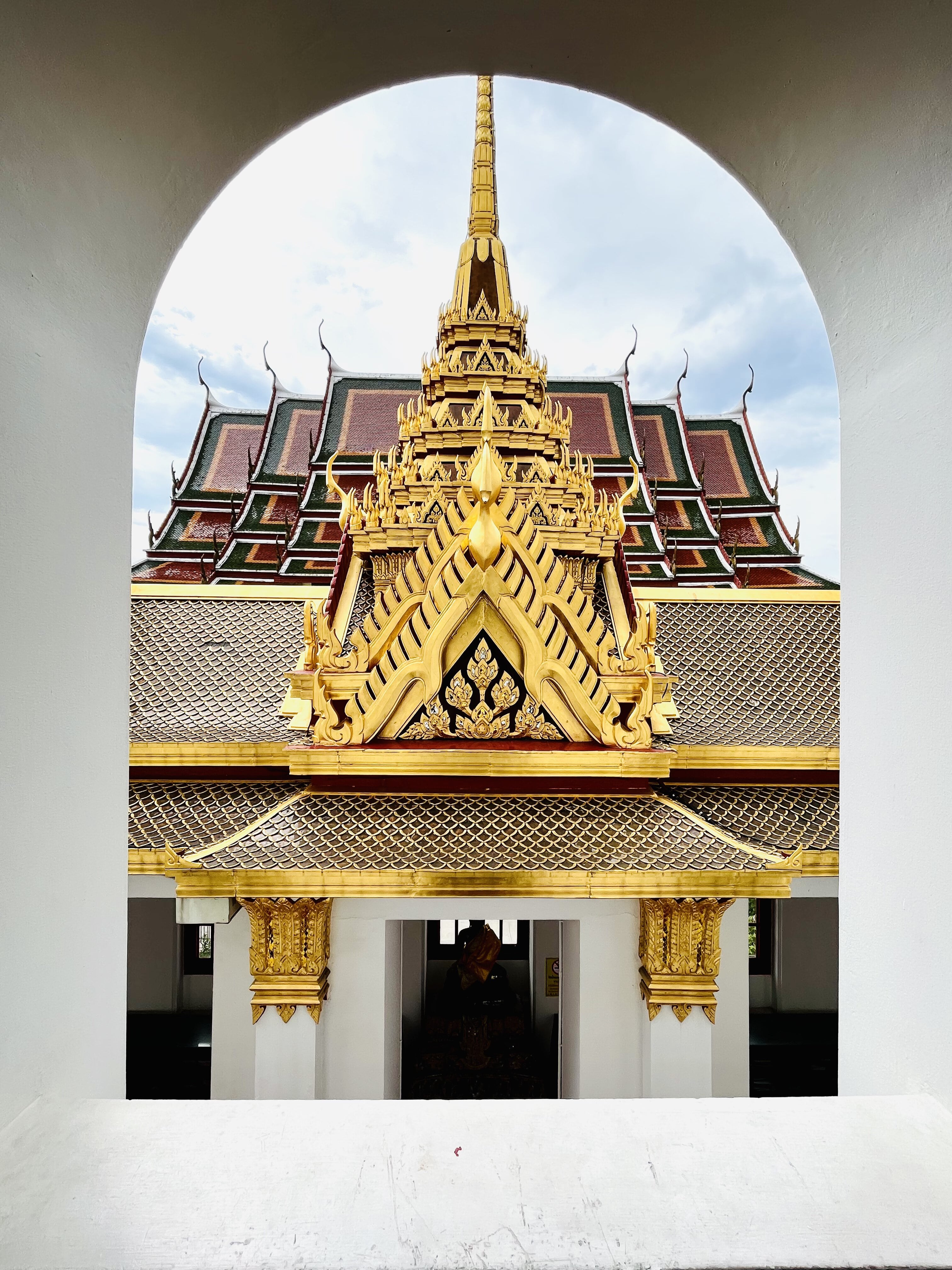
Just beside is Wat Ratchanatdaram with a uniquely decorated centrepiece known as the Loha Prasat Temple. Of immense significance to the Buddhist world, this squarish five story building has 37 metal spires on its roof, symbolising the 37 virtues required to attain enlightenment.

It was constructed by Rama III in 1846 and restored over the years, most notably in 2016 by the Fine Arts Department. This third-in-line temple, currently under a bid for a UNESCO World Heritage title, replaces the previous ones constructed in Sri Lanka and India, which have since fallen into ruins. Originally, the structure was constructed in brick, which would have lent an authentic and historical feel, but after restoring the walls with plaster to better preserve it, the original charms have been lost.

The ground floor of the Loha Prasat Temple has many corridors arranged in a grid-like pattern, with raised wooden platforms for monks to mediate. Further in, towards the central spiral staircase, information boards tell the history, starting with a monolithic structure of over 1,000 rooms built in a small town in India, of which nothing remains today. The second one, in Sri Lanka, was much smaller but it is now in ruins. This third version remains the only such structure in the world. What captivated me was an old photo of the Loha Prasat built of bricks, resembling a forgotten temple in Angkor Wat or Ayutthaya.

At each level, inscriptions at the four axises state the virtues and mindset required of that level: i.e. freedom of sexual want or thought, freedom of material desire, freedom of jealousy and so forth. As you climb higher, you transcend, through mediation, mindfulness and spirituality, from an earthly human to a divine creature, eventually reaching nirvana, or enlightenment, once you get closer to the top.

If nirvana still escapes you at this stage, be rewarded with grand views across the city – the Democracy Monument’s four wings in the distance, the recently whitewashed Mahakan Fort, and the beautiful gardens in front of King Rama III’s statue. For even better views, head to The Golden Mount, described next.

Across the road is the whitewashed Mahakan Fort, constructed as part of Rama I’s fortification for his new walled city and was in a state of disrepair until the authorities starting some refurbishment works recently. It was undergoing some serious renovations when we were there.

The park beside is beautiful when flowers are in bloom, and in the middle of the park there’s that famous staircase to nowhere that is somewhat anti-climatic in the very flat and very small park.

The nearby road bridge was built during the reign of Rama VI by an Italian sculptor and completed in 1914. It depicts panels of figures mourning the loss of Rama V and is commonly referred to as the “Weeping Bridge“. The bridge leads onto Boripat Road, which used to contain an established community of woodworkers due to the seven sawmills that were working within this area (and outside the city walls). Now, even though their once wooden-framed shophouses have been converted into bricked buildings and given over to cafes and hotels, there are still some lumber stores in business, selling carved wooden furniture.

The small lane on the opposite side leads into Wat Saket Ratchawora Mahawihan and the Golden Mount (daily, 7am – 7pm, 100฿), the only temple on a hill in the otherwise flat Bangkok landscape. At 77 metres tall, this temple was founded since the Ayutthaya Kingdom and used to sit outside the old city walls, where it unfortunately earned a rather sinister and macabre reputation (we’ll get to that later).
When Rama I moved his kingdom from Ayutthaya to Bangkok, he also renovated and enlarged this temple, and decreed for it to be used for cremations and funeral rites. During the reign of Rama III, the building of a chedi of enormous dimensions and modelled on Ayutthaya’s Chedi of the Golden Mountain was planned. For it to be visible from all parts of the city, Rama III ordered the placement of thousands of logs to fortify the base on which a mount could be built. However, under Bangkok’s soft soil, the structure weakened and collapsed, and the project was abandoned. Over the next few decades, the remains of the mud-and-brick structure acquired the shape of a natural hill and was soon overgrown with weeds.

During the reign of Rama IV (famed as the King in the musical “The King and I”, or the movie “Anna and the King”) and learning from the mistakes of his predecessor, construction began of a more modest chedi on the hill, of which the foundations were strengthened by another thousand teak logs. Upon completion during the reign of his son, Rama V, a bell-shaped structure, sanctified with a covering of gold leaf was constructed. Enshrined within it is a relic of the Buddha, dug from the hill of the old chedi in Kapilavastu, Sri Lanka, and brought by Prince Pritsadang to this site. To prevent further erosion, the surrounding concrete walls were added in the 1940s, and the modern chedi was rebuilt in the early 20th-century using Caracca marble.

But what about its gruesome past?
In the early Rattanakosin Period, it was Siamese tradition to not cremate the dead within the city walls, because it was believed to be a bad omen. Since Wat Saket was outside the city walls, the bodies of the deceased were carried out through Pratu Phi or “Ghost Gate”, which I mentioned earlier, and brought here to be cremated. This worked fine until the 1820s during the reign of Rama II, when a cholera outbreak spread from Penang to Bangkok, leading to more than 30,000 deaths in the capital.
Being the only place to cremate the dead, Wat Saket became the receiving grounds for many bodies that were carted here every day. The massive number of corpses meant that the temple was unable to cremate every single one of them, and therefore were left in the open area of the monastery, which became the target of vultures. Because of the outbreaks of cholera every dry season during the early reign of Rama V, the temple became the main dining area for vultures. The severest outbreak was in 1840 during the reign of Rama III when one in ten people in Siam and the surrounding areas were killed. This is why there are gruesome waxwork figures of vultures and dead bodies at the base of the mount to commemorate the temple’s dark history.

Wat Saket and the surrounding temple complexes are still used for cremation and funeral rites, and often there can be crowds of locals attending a cremation and the adjacent complex.
The mount is very visible from all areas in the city and it takes roughly 300 steps to climb to the very top, where views of the sprawling urban jungle that is Bangkok, is spectacular. However, the ascent is easy as the steps are not steep but form a lazy circuit around the circular mount. Along the way, speakers blast soothing but monotonous meditational chants, while ancient bells hang around the middle courtyard. Give them a strike to hear their deep, resonating tones.

At the chedi itself is a light and airy room with big windows that look out onto the city. Usually, the breeze and serenity of this place is enough to make you want to fall into meditation, or in my case, a deep and pleasant snooze. A tiny staircase leads to an observation platform on which several Thai flags flutter in the breeze, and one comes face to face with the gold covered bell that houses the Buddha relic.

This is a perfect spot to end our walk, with a commanding view over this magnificent city, set in a majestic yet serene environment, in a building that has seen much history.
It is just a short walk to some of the great eateries along Maha Chai Road, or you can continue to explore the area (visit my next post on Walk 2 of the Canals of Rattanakosin to find out more!)
