And so the bad puns continue.
Part II of my Cologne series starts from where we left off, near the restaurants and cafes around Fischmarkt, and heads away from the Rhine to cover some of the other interesting sights within the old town. Along the way, we’ll pass by fascinating museums, picturesque churches and take a stroll through Europe’s busiest shopping street. Oh, and we’ll also go for a jaunty walk along Köln’s new waterfront city, Rheinauhafen, and visit its star attraction, the Schokolade Museum (or Lindt Museum). Let’s take another whiff of the exciting city of Cologne.
Start at Fischmarkt along the banks of the Rhine. With some foresight and prudent city planning, the city has redeveloped the riverside into a people-friendly leafy park, where a noisy and busy highway once ran. Now, a tunnel underneath your feet whisks cars and trucks away from the surface, preserving the peace of the area and making for a pleasurable stroll all the way from the new waterfront city to the Hohenzollern Bridge and beyond.
The little square that is Fischmarkt was previously surrounded by medieval-looking, half-timbered houses constructed from the 13th-century. Besides being the city’s former fish market located between the city walls and the nearby church, in the later times, this used to be Cologne’s red-light district, filled with dilapidated buildings and shunned by locals (unless you’re looking for a good time). During the Nazi era of the late 1930s, these scruffy buildings were cleaned out and replaced with clean, stone-and-stuccoed buildings. After WWII, as part of the 1947 city planning, the area was restored to its former appearance, complete with faux-medieval styled housing. The narrow, steep-roofed pastel-coloured houses look extremely fetching in the early morning and worthy of an Instagram post.

Looming over the square is the imposing Groß St Martin (Great Saint Martin Church) (1pm – 725pm) a Romanesque church with a large, distinctive castle-like tower with four turrets. Together with the twin spires of the Cologne Dom, it defines the city’s skyline. Formerly an island in the Rhine, this area was the site of several warehouses during Roman times. During the 12th-century, a church, Groß St. Martin, was built on top of them, incorporating their remains as part of its structure and transforming it into a Benedictine Abbey. When it was severely damaged in World War II, archaeological excavations underneath the choir showed an impressively a smooth transition from the foundations of the former warehouse to the church aisles. The upper parts of the church were reconstructed after the war in a typical Rhenish architecture. It’s worth going in to view the clean, uncluttered but sturdy looking interior, high ceilings and the nice stain-glassed windows above the alter.

Besides Groß St. Martin, Cologne, being Rome’s provincial capitol in Germania Inferior, has 11 other large Romanesque churches, all Catholic and built between the 4th and 10th-century, set within the city centre. These churches include outstanding examples such as the Basilica of St Apostles near Neumarkt in the west, Basilica St Kunibert further up along the Rhine, and Basilica St Ursula (closed Mon, 4pm – 6pm), situated just north of the Hauptbahnhof. The last example sits on a former Roman cemetery said to be the burial ground of many virgins, and within contains an impressive yet creepy reliquary and ossuary chapel called the Golden Chamber, where the bones of the former cemetery inhabitants, including St. Ursula herself, are on full display.
Coming back to Groß St. Martin: behind the church is the Altermarkt (or Old Market), a historic towns square with picturesque buildings that used to be joined to the Heumarkt (now separated by Unter Käster) forming one long square. During the late Middle Ages, this square was also the site of public executions and the occasional jousting tournaments. Within the Altermarkt, there are only two authentic historic houses remaining. Called the zur Bretzel and the zu Dorn, they were built in the 16th-century in a Renaissance style and stand on the east side of the square. In the middle of the square is a fountain erected in 1884 dedicated to General Jan von Werth, who led successful conquests during the Thirty Years’ War, a war largely due to a continuation of the religious conflicts between the Catholics and Protestants.
The Historisches Rathaus (Old Town Hall) (closed weekends, 2pm – 10pm) is also located here. This is Germany’s oldest town hall spanning 800 years of history. This gothic building was in a constant state of construction, with the oldest part dating back to 1330 and the tower, arcade and Spanish adjacent building added in the 15th, 16th and 17th-century, respectively. The distinctive tower is 61 metres high and was once decorated with 130 stone statues. Most of the originals were destroyed in the war, and during reconstruction, 124 were erected, depicting famous historical figures and Saints associated with Cologne up to the Middle Ages: St Ursula, Charlemagne, Farina (of Eau de Cologne fame) and Wallraf. Today, prospective couples can use the Tower’s cellar as a wedding venue.

This area is also home to some local restaurants and cafes for you to grab a quick lunch, or to sit al-fresco style for a relaxing meal. Or if it’s Christmas, then rubbing shoulders with locals carrying a hot bowl of grilled champignons and some reibekuchen (fried German potato pancakes) whilst poking your nose around stores selling carved wooden figurines and local moonshine is definitely an experience worth remembering.

Just a stone’s throw away is the Wallraf-Richartz Museum, filled with medieval and Renaissance art and described in my earlier post. Directly opposite, with the striking coat of arms and the large 1709 lettering on the facade, is a famous local institution (really, this is the one) and most associated with this city’s namesake. This being Cologne, the birthplace of the scented fragrance, there is naturally a lot of emphasis dedicated to the history and promotion of this product.
The original fragrance can be found here at the Duftmuseum im Farina Haus shop (daily, 10am – 7pm, €8), which also features a museum showcasing 300 years of fragrance history. For it was here at Farina, the original Eau de Cologne (or water from cologne), that a spirit-citrus scent created by Italian perfumer Giovanni Maria Farina was born in 1709. Just a year before, Farina wrote to his brother to say that he had concocted a fragrance that reminded him of his hometown in Valle Vigezzo, Italy. He named it Eau de Cologne in honour of his new hometown here (remember that this was the early 18th-century when Cologne was a French Republic).
Farina is actually the world’s oldest fragrance company whose Eau de Cologne was used by many European royals in the past and continues to be popular to this day. However, their products are less well-known than the House of No 4711 (daily 930am – 6pm), with its flagship shop located just a few streets upstream along Glockengasse, where in 1792 (just a little later than Farina’s discovery), a local businessman called Wilhelm Mülhen obtained the secret recipe for an “aqua mirabilis” from a Carthusian monk.
Quickly realising its significance, Mülhen founded a small distillery in this house and marketed the product as a health drink (yes, people drank perfume in the past) and elixir for life for internal and external use. After a Napoleonic decree requiring all medicinal recipes to be made public, various Eau de Cologne manufacturers advertised their products as a fragrance to avoid disclosure, and hence nobody drinks it now (but just think how nice-smelling your insides will be).

Today, their 2-storey shop has the original scent and new varieties in various combinations, and they do guided tours that explain its rich heritage with over 230 years of history, with precious objects on display such as vintage perfume bottles. In fact, 4711 is so well known that even my mum recalls her mum using it when she was a young girl (from an old-wife’s tale to use cologne as a fever remedy).

On the second floor loft, a long glass cabinet showcases some of 4711’s previous fragrance bottles that look extremely regal and classy, packaging for perfume bottles and exquisite carry-cases, as well as a large old-school cash register. The displays are a delight to peruse. However, the big question is, if 1709 is the year when Farina started selling its cologne, how exactly did 4711 Eau de Cologne get its unique identifier?
History goes that the French occupation in the late 18th-century introduced a numbering system for all the houses in Cologne. The house belonging to the Mülhen’s family here on Glockengasse was designated as No 4711, which later lent its name to the 4711 Original Eau de Cologne identifier. A plaque outside the shop front captures this detail, while a large woven tapestry hanging inside the shop shows the image of a French soldier etching out the number 4711 out on the shop front.

Chewing on that pretty neat tidbit, just around the corner is another cool place to check out. The Kolumba (closed Tue, 12pm – 5pm, €8) is a museum housed in a modernist and perforated greyish building that was constructed on the site of the former Romanesque church of St Kolumba. This church was one of the most important parishes in Cologne as well as the oldest, and unfortunately it was destroyed in the war.

The footprint of the building and some other historical roman ruins can still be seen as part of the exhibits on the ground floor, including the former chapel built in the 1950s that was called the Madonna in the Ruins.

Enter through its unassuming entrance along Kolumbastrasse into a zen-like interior, with a minimalist foyer that looks out onto a large picture window of a modest garden with sculptures of brass and bronze. At the corner and through a large silver sliding door is a walkway that extends out over the former church ruins. According to the site layout, this church probably started out with a single nave but gradually grew to become a five-nave church in the 13th-century.

Along the way, one can see the foundations, brick walls, and footprints of the former church. At the end of the walkway are floor tiles from St Kolumba and some stone blocks with lettering chiselled. The whole place looks dark, gloomy and chilly (since it leads directly to the outside) and lends to that mysterious feel- the type where you speak in hushed, wondered tones.

Upstairs on its three floors are rotating exhibits, ranging from paintings, drawings, prints, sculptures, decorative art and religious icons from late antiquity to the present. Some of the highlights include a 12th-century ivory crucifix in a Rhenish style; an 11th-century processional cross (Hermann Ida Cross) made of gilded bronze, and some late gothic artwork by German artist Stefan Lochner (pride of the Wallraf-Richartz Museum’s collection). On the upper floors are modern works of art.

Most artwork are without much descriptions, although the front desk provides a handy booklet that neatly summarises details about the artist, descriptions of his artwork and what the artist intended to convey. The exhibits are done up in that eclectic manner that juxtaposes old medieval crucifixes with modern contemporary art, allowing the visitor to draw his or her’s own interpretation conclusions.

If one were to cut down Herzogstrasse, one will end up along the beating heart of Cologne, Schildergasse. This broad pedestrianised zone, touted as Europe’s busiest shopping street and Cologne’s second oldest, is filled both with traditional shops such as Riese confectioner and modern chain boutiques like Zara and H&M. Besides these crowd pleasers, there is a wide range of street musicians, cafés and snack stops. Every day, as many as 70,000 people stroll along its 534 metres in length, making their way from Neumarkt in the west to Cologne’s second major shopping mile, Hohe Straße, in the east. During Christmas, twinkly lights in all shapes, colours and sizes adorn its full length.

At the fork in the road that splits into Schildergasse and Gürzenichstraße, you’ll come upon a square that features an eight-metre-high granite column. This is called the Beer Fountain, and erected here to remind passersby of the Brewers’ Guild Hall, which used to stand a few metres away until 1927. Why this quirky name? This is because it used to be possible to draw a glass of Kölsch beer here on certain occasions, thanks to an underground pipe leading to a nearby beer wagon.
A few minutes down is Neumarkt, a pleasant tree-lined square that offers gorgeous views of another Romanesque church, Basilika St. Aposteln (Basilica of St Apostles). It’s facade looks similar to that of Bonn Cathedral, with two distinctive flanking towers.

This three-nave church, completed since the 11th-century, was significantly enlarged in the 13th century. In addition to the domed cloverleaf choir in the interior which was constructed in 1200, the octagonal dome above the crossing (at the junction of the four arms of a cruciform church) was also built around this time, giving St. Aposteln a monumental, almost Byzantine appearance.

A short walk further west brings you to one of the fully restored Roman gates in the city. This massive gate with crenellated round towers, is called Hahnentorburg, or Rooster Gate. It was constructed between 1235 and 1240 when Cologne was surrounded by a medieval wall and fortified with 12 magnificent gates. This gate at the western end was considered the most important, as the German kings who arrived in Cologne after their coronation in Aachen passed under it on their way to revere the shrine of the Three Magi in the Cologne Cathedral. Since then, this defensive gate has been used as a prison, museum and exposition hall. Nowadays, it is used by a carnival society, and in Christmas it opens out into a nice Weinachtmarkt (Christmas Market).

Having roughly covered the main sights in the old city, perhaps a change of environment is in store. Backing to the waterfront and a short walk along the Rhine from Heumarkt is the sleek and stylish new district of Rheinauhafen (Rhine Harbour), home to large corporate offices such as Microsoft, EA Games and Birkenstock. Before that, make a visit to the Historische Senfmühle (Mustard Mill and Shop) (daily, 10am – 6pm), with its gift shop that sells delectable homemade mustard products and museum that sheds light on its history. The shop is located opposite the Malakoffturm, a bricked tower that forms the remnants of the old city wall.

This mustard mill is one of two mills (the other is in Cochem) and dates back to the 18th-century, amongst the oldest in Europe. After being sold to Holland, the present owners had lovingly restored them back to its original working condition in 2001, which included the ability to demonstrate its full range and production process as part of the museum’s guided tours (which seems to have stopped recently). This shop in Cologne was opened in 2009, and carries a large range of flavours such as its classic recipe from the 1820s, a Christmas special with gingerbread spices, and one made specially with Cologne’s beer – the Gaffel-Kölsch (we got that naturally). Their products are sold either in a cute stone pod (250ml, €8.90) or a more practical plastic bottle.

Directly opposite, an old iron swing bridge greets you to the start of the Rheinauhafen island. Called Drehbrücke im Rheinauhafen, this is the oldest bridge in Cologne and it was constructed in 1896. It leads directly to the large glass and metal structure that is the immensely popular Schokoladenmuseum Köln (Lindt Chocolate Museum) (daily 10am – 6pm, €15.50) which touts itself as the world’s largest exhibition on cocoa and chocolate. Being one of the Cologne’s biggest cultural institutions which draws 650,000 visitors yearly, it is best to buy a pre-timed admission ticket via its website first (https://www.schokoladenmuseum.de/besuch-planen/#tickets-gutscheine) to avoid disappointment. They also do special guided tours on its museum exhibits and chocolate making factory.

The ground floor lobby is where the gift shop, cafe (which is always crowded and sells selections such as chocolate fondue, cakes or just some delicious pick-me-up hot chocolate with rum) and lockers are. It is also the entrance of the museum, which starts of about the history of Hans Imhoff, a passionate chocolate manufacturer and economic pioneer. A sort of Willy Wonka of his time, he had dreamt of a chocolate museum with a chocolate fountain that bubbles endlessly, and in 1993 he got his wish with the opening of this museum.

In the next few rooms are fascinating exhibits on the type of climates that the cocoa bean grows in (including a greenhouse), how it is cultivated, harvested, transported and sold in the markets. Granted, the actual colour and texture of the cocoa bean is not the type you’d associate with the final output. It also has some fun hands-on activities such as splitting and examining cocoa beans, and guessing which country eats the most chocolate (I’m not telling).

The next section forms part of the actual chocolate factory, highlighting the types of ingredients that goes into making this sweet treat and allows you to follow the journey of the cocoa bean from being roasted to packaged. Several industrial machines that mix, roll and prepare the little cubes of chocolate stand in the room, and allow you to peek into the process.

Great for both the kids and adults alike is a station in the middle that, with a press of a button, allow the robots to give you a piece of chocolate from the production line.

Immediately after the production line is the 3-metre high, gold covered chocolate fountain that is always filled with 200kg of fresh Lindt chocolate. Ask the servers to hand you a wafer generously dipped into the rich pool of melted chocolate. Upstairs, in the hollow figure studio, one can see their maitres chocolatiers painstakingly handcrafting chocolate into beautiful and multi-coloured art forms (well, mainly just white and milk chocolate) such as easter bunnies, teddy bears and Santa Clauses. There are also unusual shapes such as cars and buses, elephants and unicorns! There’s also a place for you to create your very own chocolate bar with a combination of three types of chocolate and many other ingredients such as fruits and nuts.

The adjoining rooms thereafter tell the history of the discovery of the cocoa bean, how the ancient Aztecs created the first chocolate drink (sans milk and sugar) 5,000 years ago, and how it was brought to Europe as an indulgence at the courts of nobility and the clergy. Then, as it is now, chocolate has always been a favourite and luxury item. The exhibits also feature some very ornate chocolate serving dishes, pots and cups made with fine china and adorned with intricate patterns, resembling those used to serve tea.

And finally, on the third floor is the grand finale, a colourful and quirky room with 10 stations symbolising our feelings with chocolate, including a screen that allows you to feed chocolate to a emoji to watch it turn from “Hangry” to happy.

The chocolate museum is worth a visit because it combines the rich and fascinating details of this ubiquitous product, and the fun and excitement of watching it being prepared, with grand views of the Rhine. Oh, and you get free samples of its iconic class recipe squares and a Lindor milk chocolate!

Just after the museum are long rows of beige-bricked warehouses fronting the river. These have been gentrified with modern plumbing and amenities and are now home to cafes, corporate offices with panoramic views, as well as another interesting museum dedicated to the Olympic Games.

Called the Deutsches Sport & Olympia Museum (daily 10am – 6pm, €9.50), it opens up a fascinating window into the world of sports and the Olympics, with over 2,000 exhibits on the topic of sports ranging from a Formula 1 car driven by Michael Schumacher to a pair of boxing gloves worn by Muhammad Ali.

The museum also explores the greatest moments in sports, highlighting impressive victories and defeats, and covers historical events such as the 1936 and 1972 Olympics in Berlin and Munich, respectively.

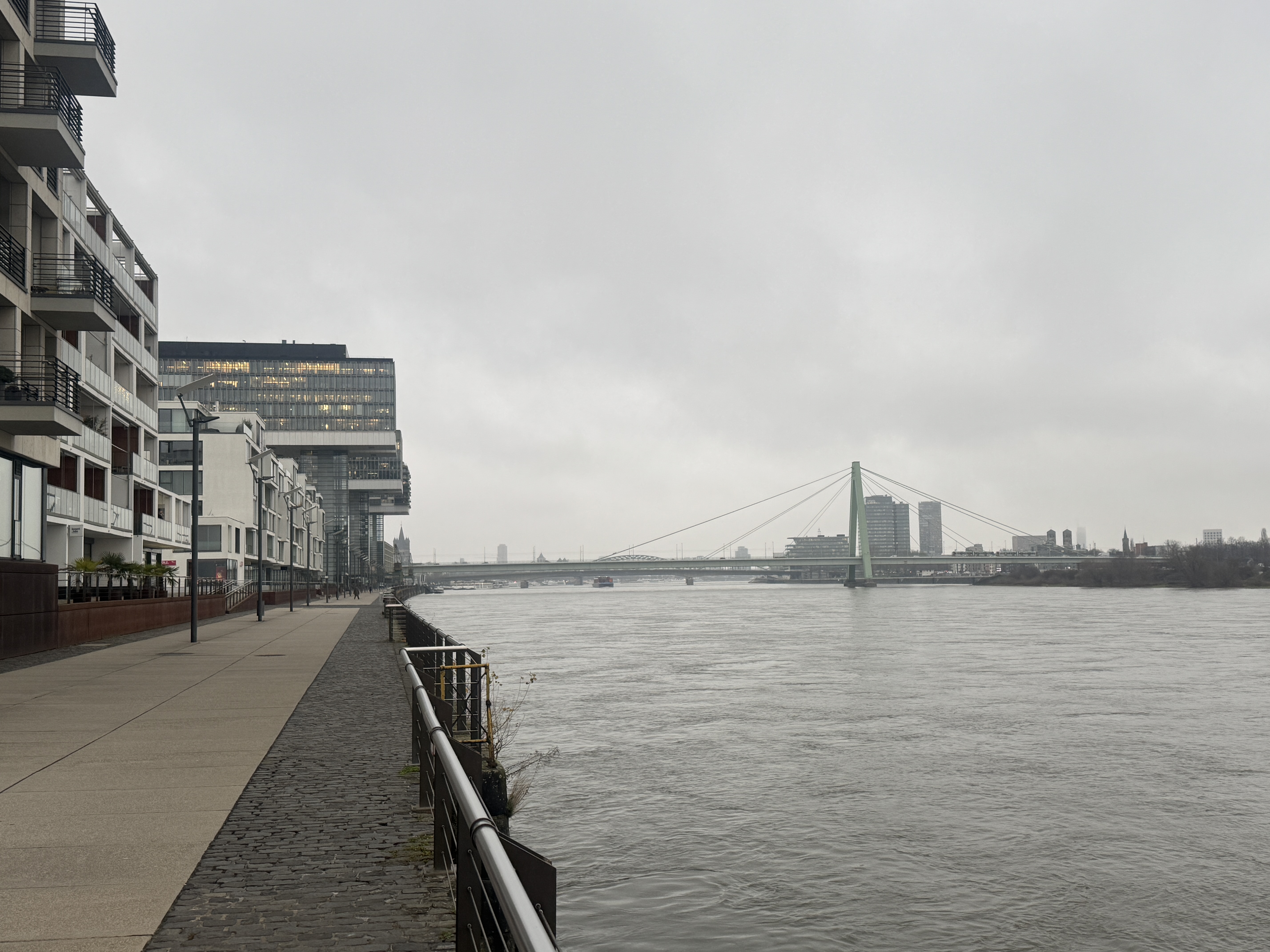
Further down and past the road bridge, are the three state-of-the-art apartment and office buildings known as the Kranhäuser (Crane House). Visually striking because of their usual appearance, this glass-covered facade features a two-part cantilever arm that juts out at a height of 40 metres from a slender, fully glassed-in stair tower, resembling the modern port cranes that help to carry containers off ships. The three buildings were completed in 2008 and offer approximately 53,000 square metres of floor space in total; there is even a Michelin-star restaurant called the Ox & Klee located in the middle tower.

A stroll upstream brings you to Bayenturm, an old tower built around 1220 that formed part of the original city wall. For many centuries, it was regarded as the city’s hallmark. Badly damaged during WWII and not renovated until the 1990s, today this medieval structure is known as the Frauen Media Turm (Women’s Media Tower).

In addition to the Bayenturm, there are other interesting and impressive architecture dotting the riverfront, such as the Siebengebirge residential complex with its nine roofs, a former grain silo-turned-office called Silo 23, and the Hercules Crane, a listed historical harbour crane that once used to lift the 24 ton St Peter’s bell that now hangs in the steeple of the Cologne Cathedral. Below your feet is Europe’s longest, and world’s second longest, carpark, at 1.6 kilometres long with the ability to accommodate 1,400 vehicles.
This walk has ended. You can follow the riverfront all the way back to the Hohenzollern Bridge. Alternatively, head down to Heumarkt along Schildergasse for some proper beer (Kolsch, of course) and wholesome fare. You’ve earned it.
