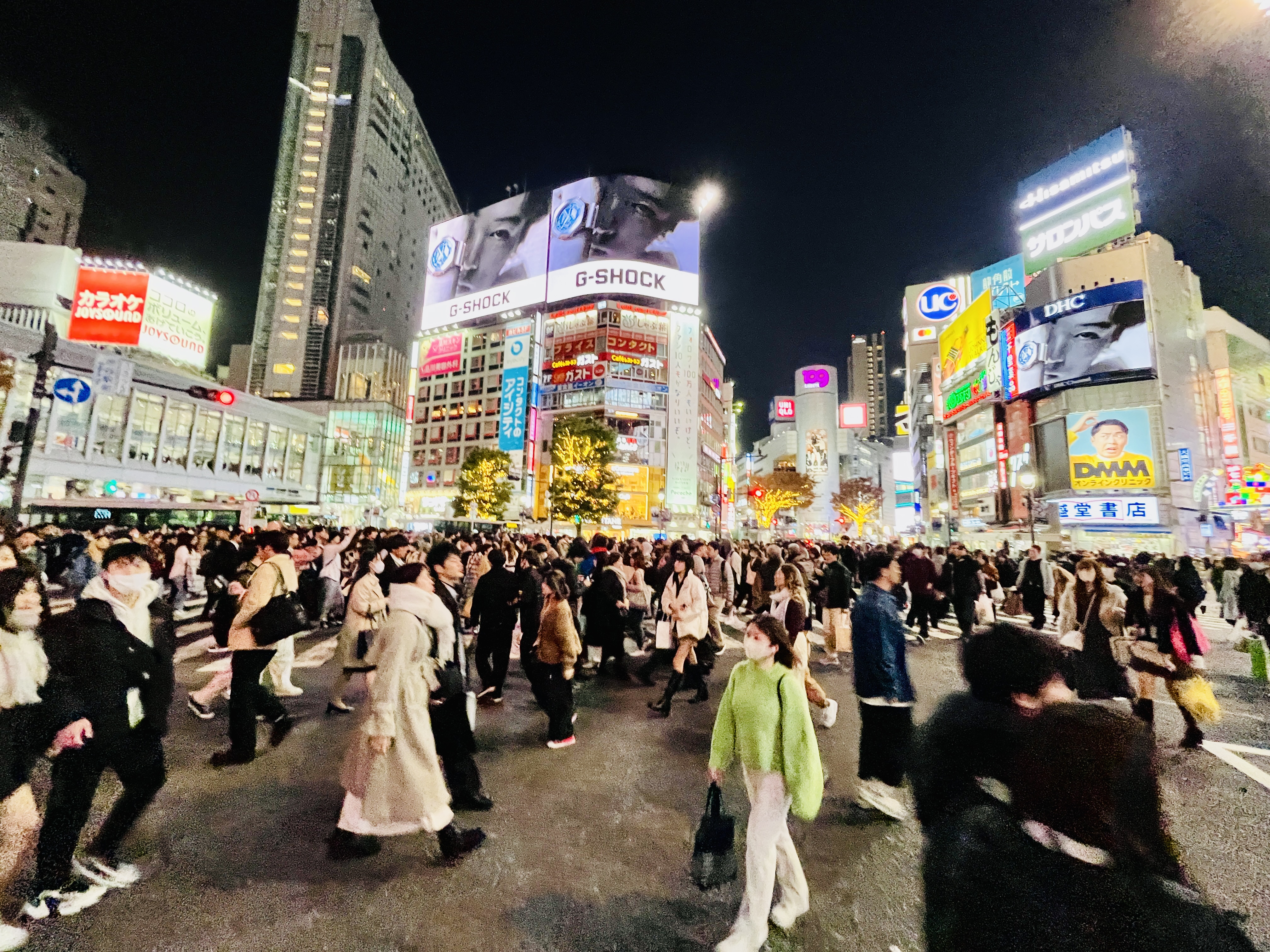
Just two stations down the Yamanote Line, Shibuya is Shinjuku’s twin sister. It has the same energy and vibe, the same crowds, and the same type of stores. Shibuya’s most iconic feature is probably its famous scramble crossing just outside the station. One the busiest in the world, with up to 3,000 people crossing at any one time, it is beautifully set against the backdrop of large digital advertisement boards and tall skyscrapers, and this mode of crossing has since spawned into numerous “mini Shibuya crossings” around Tokyo and the world. So step off the kerb and get lost in the crowds. Let Shibuya consume you.

While wading into the crowds during a crossing can be quite an immersive experience, nothing beats viewing it from above, and the best and cheapest (free) way to do it, now that the 2nd floor Starbucks at Shibuya Tsutaya has closed, is from the 2nd floor of the Shibuya Station concourse between Shibuya JR Station and Mark City. Just opposite the viewpoint is the eye-catching mural, Myth of Tomorrow, by Japanese artist Taro Okamoto, covering the full length of the upper concourse. It depicts the point of explosion of an atom bomb, with its mushroom cloud growing as skeletons burn under the tentacles of fire.
Interestingly, Okamoto started this artwork in 1967 when he was commissioned to paint a mural for a new hotel in Mexico City. However, after completing it in September 1969, the hotel went bankrupt and his work was never displayed. After being forgotten for decades, Tarō’s secretary and life partner, Toshiko Okamoto, finally discovered it in 2003 in a Mexican suburb, and, together with her supporters, transported it back to Japan to be restored at this very spot.
Directly below the concourse is the little statue of Hachiko, the Akita dog who used to accompany his master on his daily commute home from Shibuya station. One fateful day, his master failed to turn up because he had passed on in the office, but Hachiko continued waiting at the station every day for 9 years until he himself passed away. Hachiko’s devotion and loyalty to his master is a lesson for us all, and crowds usually gather to snap pictures of the adorable dog.

On the other side of the scramble crossing is Shibuya’s Central Gai, a pedestrianised street lined with big chain shops, shopping malls and restaurants that are always crowded with people. Along the route you will find shops such as the 24-hour, 7-floors mega Don Quijote, women’s fashion mall Shibuya 109, electronics store Yamada Denki LABI and H&M. Further in along the side streets, you can also find Shibuya Parco, which has a dedicated Nintendo store.

The Mega Don Quijote is something of a monster, with 6 floors selling clothes, makeup, toiletries, knick-knacks and stuff you didn’t even know you needed, as well as 2 basement floors of food and fresh produce. It even has a tax-free counter on the 6th floor. Being a sort of discounted superstore, the layout is generally claustrophobic, with narrow alleys piled high with packaging, harsh lighting and discount signage that you leave you in spasms – basically Shibuya in merchandise form.

Directly opposite and part of the new skyscraper look and feel of this district is the new Shibuya Scramble Square. This mega complex has seven floors dedicated to fashion, five to food halls and restaurants, and right at the top on the 47th floor is the Shibuya Sky, an observation deck that has sweeping views over the city (¥2,200 per person). It is probably the next best place to view the scramble crossing, albeit from very high up. Nearby, Shibuya Stream utilises the former platforms of the Toyoko Line at Shibuya Station. Running along an actual stream, this shopping cum hotel and office complex has relaxing and chic cafes on the first floor, and sleeker restaurants on the second to fourth level with great views of the scenery below.

Close to Centre Gai and opposite Shibuya Station, a long flight of stairs announces the entrance to a quirky, elongated building known as Miyashita Park, looking like a futuristic train station. Formerly a park running along the Yamanote Line, this three-storey shopping mall filled with fashion and gourmet shops, restaurants and souvenir shops, is split into a North and South block joined in the middle by a crossing above Mitake Street. On the top floor is a pleasant open-air park with cafes, a rock-wall and a skateboarding rink. Slanted benches and tables allow you to perch over the railings and look down at the shoppers or trains rumbling below. At night, Miyashita Park is bathed in an azure blue hue- an invitation of calmness and serenity.

Along the ground floor and spanning almost the length of the South Block is Shibuya Yokocho, an exciting gourmet area constructed in a likeness of a typical, traditional yokocho. It houses small restaurants and izakayas selling everything from yakitori skewers, to sushi and ramen, with highball, beer and sake options. Since they are not as small and as exclusive as those around Omoide Yokocho in Shinjuku, or even an actual one just down the street called Shibuya Nonbei Yokocho, the stores are usually packed with young locals during dinner and the mood is very festive, especially on weekends.

On the other side of Shibuya Station, at the South entrance, is the lovely Sakura Street, which blossoms with sakura flowers during March, and lights up at night during the winter. There are some great teppanyaki restaurants and bars along the side roads for you to take a break after hours of shopping.

If you crave the incense of high quality tea leaves or want to watch skilful tea masters prepare your tea in a ceremony without the traditional fuss and rigmarole, the Sakurai Japanese Tea Experience near Shibuya may be your answer. Located at the fifth floor of Spiral, an art complex with a curving walkway along Aoyama-dori, it effortlessly fuses traditional and modern methods of tea making and sampling, and presents them, with a certain polished flair, in a relaxed yet classy environment.

Hailed as a research centre that constantly explores ways to create new possibilities for the enjoyment of tea, its menu features several tea-drinking courses (including a tea and liqueur course) as well as light meal courses that come with varying snack accompaniments. Customers are allowed to view, sniff and select various blends and grades of tea at their online shop just beside, and they do have a wide selection ranging from the finest blend, to those that require an acquired taste (think mouldy and woody). As a testament to its seriousness in cultivating a memorable experience, the website has a long list of dos and don’ts, including one on barring customers wearing excessive perfumes.

We selected one a middle-tiered light meal course (around ¥5,500 per person), which came with three tea pairings featuring Gyokuro- tea leaves grown under shade and therefore more expensive to harvest but packs a nutritional punch; Bancha, which is tea from the second flush of Sencha and usually more astringent and less aromatic; and Matcha, the typical drink served at most tea ceremonies and most associated with a prized tea in Japan. The difference between Sencha, Bancha and Matcha, is that the first two are brewed by infusing whole leaves in hot water and then drinking the extract, whereas Matcha is mixing powdered tea leaves with water and consuming the concoction.
For the uninitiated, tasting Gyokuro is indeed an experience, as the first pass through hot water and timely steeped in a beautiful ceramic pot resulted in a tea that was umami, tasting almost like a broth. It was only after several passes that the savouriness from the leaves subsided, leaving behind the familiar flavours of tea.

In between the tea servings are wonderfully created snacks such as chestnut steamed rice, grilled baby river fish, and seasonal wagashi, a kind of sweet paired with Matcha. Their creations were beautifully plated, simply seasoned, yet heartily delicious.

Besides getting a chance to sample the various types of tea, the helpful and knowledgeable brewers also briefly describe the origins of the tea being served, the specifics of how it is brewed, and how it is to be consumed. The entire experience took 1.5 hours, which was adequately timed to ensure another seating. Make a reservation on its website (https://sakurai-tea.jp/en) to avoid disappointment.
The Sakurai Tea Experience leaves you relaxed, recharged, and ready to step out to get lost in the crowds once more.
